Showing posts with label Militia. Show all posts

Thursday, February 12, 2009

Abraham Lincolns Birthday

Today is the 200th anniversary of the birthday of Abraham Lincoln, the sixteenth president of the United States. Upon his election to office in 1860 the long simmering differences between the north and the south over the issue of slavery quickly turned into an open conflict. Even before Lincoln was sworn into office, state legislatures in the south began to pass legislation calling for secession from the Union.

On April 12, 1861 with the firing on Ft. Sumter in Charleston, South Carolina President Lincoln issued an executive order to the states to call out their volunteer militias t0 put down this rebellion. This caused the last holdovers in the south to choose sides and many chose to defend their home states against this "aggression" from the North.

Most famously U.S. Army Col. Robert E. Lee of Virginia, who had been offered command of the Federal forces, assumed command of the Northern Army of Virginia in 1862 and fought for the Confederate States of America. His divided loyalties was just one example of many and a bloody civil war of brother against brother ensued. The American Civil War, or the War between the States, lasted for four years and the fighting cost the lives of over 600,000 Americans on the battlefield.

Monday, August 18, 2008

American Presidents and the military

President Washington

It is a conflict as old as mankind: humanities desire for peace versus a recognition of what also appears to be a part of man's make-up - an urge and a genius for making war on his fellow man. Democratic nations feel this conflict most keenly as recognizing the rights of the individual is the cornerstone principle of their governments. Autocratic and authoritarian governments will usually put the perceived needs of the state before the needs of individuals.

A reluctance to create a permanent standing Army and Navy was very much a part of the make-up of this country's Founding Generation. They felt that creating such a force would be a threat to their newly won freedoms. But being pragmatists, the Constitution that they created does layout the framework for our national defense. The American President is the Commander-in-Chief of our armed forces, giving a civilian the ultimate authority. Congress is granted the powers of the purse and the power to declare wars.

A slim majority of U.S. Presidents have served in the military, either on active duty or with the militia or National Guard. A surprising number of them held very high rank in the military. Beginning with our first President, General George Washington, Commander of the Continental Army, three U.S. Presidents held the rank of General of the Armies. The other two were U.S. Grant in the Civil War and Dwight Eisenhower in World War Two.

Andrew Jackson the "Hero of New Orleans" and William Henry Harrison both reached the rank of General in the War of 1812. Zachary Taylor fought in the War of 1812 and served as a Brigadier General in the Mexican-American War. Franklin Pierce, Rutherford B. Hayes and James Garfield all held the rank of General in the U.S. Army in the Civil War.

Several other U.S Presidents were also decorated soldiers and war heroes. William Mckinley was wounded in the Civil War. Theodore Roosevelt served as a Colonel with the Rough Riders in the Spanish-American War and was recommended for the Medal of Honor. Harry Truman was a artillery Captain in the First World War. John F. Kennedy was captain of a P.T. Boat and George H. W. Bush was a navy pilot, both in World War II.

At many points in our history having served in the military was a prerequisite for seeking political office. This was especially true after the two major all-inclusive wars of U.S. history - the Civil War and World War Two. Beginning with Harry Truman becoming President in 1945, every U.S. President, except William Clinton, has worn the uniform of the U.S. military. With the ending of conscription (the Draft) in 1973, that run of veterans (1945-1993) in the White House will most likely never be matched again.

Sunday, August 10, 2008

Logan International Airport - East Boston, Mass.

Logan Airport
East Boston, Mass.

Boston's Logan International Airport was officially opened on September 8, 1923. Built by the U.S. Army Air Corp, the air field was originally called the Boston Airport. In its first few years it was mostly used by the Massachusetts Air Guard and the Army Air Corp. It remained in Army hands until 1928 when the Massachusetts legislature and then the City of Boston took possession. In 1941, just before the outbreak of World War II, the State of Massachusetts took final ownership. In 1959 MassPort, a quasi-independent state agency, took over operations of the airport.

In 1943 the Mass. legislature passed a bill renaming the airport the General Edward Lawrence Logan airport. Born in Boston, Gen. Logan had served with the 9th Massachusetts Volunteer Militia in the Spanish-American War. Called to active duty again he served with the newly created 26th Infantry division and fought in the first world war. After the war Logan remained with the Mass. National Guard and rose through the ranks until reaching the rank of Major General commanding the 26th (Yankee) Division. Gen. Logan also served on Beacon Hill in the Mass. legislature, as head of the Mass. District Commission (the M.D.C.) and as a Judge of the South Boston District Court. He was a graduate of Boston Latin, Harvard College (class of 1898) and Harvard Law School.

The airport has grown exponentially over the years, both in its overall size, the number of flights and passengers and in the number of airlines. Massport is in the final stages of a multi-year improvement and building program which has led to the completion of new passenger terminals, parking areas, walkways, hotels and roadways. Logan airport is accessible by mass transit and by auto through the Sumner/Callahan and the new Ted Williams tunnels. Those wanting to avoid the tunnels and the tolls may drive in from Revere and East Boston.

Monday, August 4, 2008

Brooks Estate - Medford, Mass.

Brooks Estate
275 Grove St.
Medford, Mass.

Living in and surrounded by the crowded urban life of eastern Massachusetts today it is hard to imagine that in times past large tracts of open and sometimes forested, land still existed. Not just small working farms, but often the land was part and parcel of large estates owned by wealthy individuals and families. These personal estates, some of them consisting of hundreds of acres, were in most cases eventually broken up and sold off by the families descendants many years ago.

Occasionally, the estates were preserved long enough so that the open space remained, which we can now enjoy in public parks and conservation land. In some instances, the family mansions along with their grounds survived, giving us a glimpse of how they lived in the 18th and 19th centuries.

Founded in 1630, Medford was one of the earliest English settlements in the New World. Originally established as a "Plantation" it was owned by an absentee landlord in England. The Mystic River, which was one of its early boundaries, gave access to the sea and provided an abundance of "alewifes", a type of fish. (For which Alewife Brook Parkway, Rte. 16, was later named).

In 1660 Thomas Brooks, a puritan from Boston, purchased about 400 acres in Medford, establishing the Brooks Estate. The Brooks family went on to play an important role in the history of Medford, the Mass. Bay Colony and later in the Commonwealth of Massachusetts. To mention just two members of the family: John Brooks, a Captain in the American Revolution and a Major General in the militia, served as Governor of Massachusetts and the Rev. Charles Brooks was an influential minister, educator and an historian.

In the 1880s Peter Chardon Brooks III and Shepherd Brooks decided to build summer homes on their family owned property in Medford. At that time, Medford was still comparatively rural. Peter's home, Point of Rocks, no longer exists, but the manor built by Shepherd Brooks still stands.
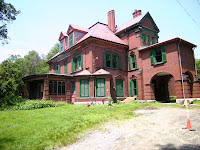
Originally called the Acorn, the four bedroom red brick home was designed by Peabody and Sterns. Its granite foundation was built from stone taken from the old Middlesex Canal, a portion of which used to run through the Brooks Estate. A large carriage house was built adjacent to the manor.

In addition to building the two homes a massive construction effort was completed in the creation of Brooks pond. This pond was dug by hand and required the removal by trucks of tons of earth. At the same time vistas were opened up among the forested land to allow the proper viewing of the property.

The Brooks Estate decreased in size over the years as property was either sold - as in the creation of the Oak Grove Cemetery and its additions - or donated for public use. After the deaths of Peter and Shepherd, more of the property was sold by their heirs. In 1942 the City of Medford acquired what remained of the estate, which at that time was about 88 acres. Point of Rock was at this time demolished, leaving only the remains of its foundation. Shepherd Manor was used as both a nursing home and a place for veterans families.

Finally after some discussion, an agreement was reached on how best to preserve the property. Late in 1998 a permanent conservation plan was approved. This plan guarantees for future generations the preservation of some 50 acres of the Brooks Estate, the Shepherd Manor and its carriage house.

The property is managed by the Medford - Brooks Estate Land Trust (M-BLT). Year round caretakers live in Shepherd Manor, looking after the two historic buildings. The Brooks Estate is adjacent to Medford's Oak Grove Cemetery and conservation land (donated by the Brooks family) in Winchester. The estate has numerous hiking trails and is quite heavily forested, giving an illusion of distance from the surrounding city.