On the 7 of October, 1780 the Battle of Kings Mountain took place in South Carolina. In what was part of a civil war in the South, British Loyalist forces under the command of Col. Patrick Ferguson were soundly defeated by Patriot Militia. Men from "over the mountain" from as far away as Virginia had gathered in the western part of the state and surrounded the Loyalists forcing them to make a stand on top of Kings Mountain.
Despite their best efforts, including three bayonet charges, the Loyalists were overwhelmed by the Patriot forces who advanced tree by tree up the slopes of the mountain. Col. Ferguson, along with many other Loyalists, was killed in the fighting. The rest of his force was captured. Interestingly enough Col. Ferguson was the only British Regular on Kings Mountain that day.
In the aftermath a number of the Loyalists were summarily executed and a number escaped while being escorted as prisoners. This victory by Patriot forces, along with another at the Battle of the Cowpens, were viewed as turning points in the War in the South. Gen. Cornwallis was forced to change his strategy and ultimately Cornwallis was forced to abandon the Carolinas and retire with his small army to Yorktown, Virginia.
The Kings Mountain National Miltary Park preserves the actual grounds of the battlefield. Allow an hour to walk the paved walking path that navigates the ridge where the fighting took place. The National Park is open year round and is located off exit #2 on Rt. 85 in North Carolina. Follow the signs back into South Carolina and the Park. (Don't be confused by the South Carolina State park with the same name). The visitors center has a short film and static display area and an excellent selection of books on the American Revolution.
Showing posts with label Colonial Militia. Show all posts
Thursday, October 25, 2012
Wednesday, June 17, 2009
Battle of Bunker Hill
Charlestown, Mass.
Today is the 224th anniversary of the Battle of Bunker Hill, the first major battle of the American Revolution. Although
the British won the battle, it was a very costly victory that gave hope to the American cause, as it showed Colonial troops could stand against Britain's best soldiers. The battle is also significant, I believe, for what might have happened to the new Rebellion if events had turned out just a little bit differently.
The initial plan was for the Colonial militia to fortify Bunker Hill, which is a higher promontory and is closer to the mainland than Breeds Hill on the Charlestown peninsula. For reasons unknown today it was decided to build a redoubt on Breeds Hill and this is where most of the actual fighting on that day took place. This placed the militia in a (potentially) very precarious position. It would have quite easy for the British Army, under the cover of the British Navy, to have made its amphibious landings behind the redoubt and attacked the fortification from the rear. This plan was advanced by General Clinton, but he was overruled.
The actual landings on the peninsula were made in front of the redoubt. The British troops were sent in a broad frontal attack, carrying full backpacks, that failed miserably. An attempt was made to turn the flank of the militia, but due to the timely arrival of Col. Stark and his men from New Hampshire, this also failed. It wasn't until a final third assault was made that the British finally succeeded in sending the militia fleeing to the rear. British forces had removed the threat to their position in Boston, but at a great cost.
What was a Pyrrhic victory for the British could easily have been a major disaster for the Colonial militia. If the assault had been made in a more timely matter and if a landing closer to the land bridge to the peninsula had been made, then the American forces would have found themselves trapped. They would have been forced to surrender in total or have been killed. A defeat of this size and nature, at this early date, may have been fatal to the American colonies fight for independence.
Charlestown, Mass.
Today is the 224th anniversary of the Battle of Bunker Hill, the first major battle of the American Revolution. Althoughthe British won the battle, it was a very costly victory that gave hope to the American cause, as it showed Colonial troops could stand against Britain's best soldiers. The battle is also significant, I believe, for what might have happened to the new Rebellion if events had turned out just a little bit differently.
The initial plan was for the Colonial militia to fortify Bunker Hill, which is a higher promontory and is closer to the mainland than Breeds Hill on the Charlestown peninsula. For reasons unknown today it was decided to build a redoubt on Breeds Hill and this is where most of the actual fighting on that day took place. This placed the militia in a (potentially) very precarious position. It would have quite easy for the British Army, under the cover of the British Navy, to have made its amphibious landings behind the redoubt and attacked the fortification from the rear. This plan was advanced by General Clinton, but he was overruled.
The actual landings on the peninsula were made in front of the redoubt. The British troops were sent in a broad frontal attack, carrying full backpacks, that failed miserably. An attempt was made to turn the flank of the militia, but due to the timely arrival of Col. Stark and his men from New Hampshire, this also failed. It wasn't until a final third assault was made that the British finally succeeded in sending the militia fleeing to the rear. British forces had removed the threat to their position in Boston, but at a great cost.
What was a Pyrrhic victory for the British could easily have been a major disaster for the Colonial militia. If the assault had been made in a more timely matter and if a landing closer to the land bridge to the peninsula had been made, then the American forces would have found themselves trapped. They would have been forced to surrender in total or have been killed. A defeat of this size and nature, at this early date, may have been fatal to the American colonies fight for independence.
Wednesday, April 15, 2009
Battles of Lexington and Concord
The Concord Minuteman
Minuteman Nat. Historical Park
Concord, Mass.
This coming weekend (April 18-20) will be a very busy weekend for Revolutionary War Reenactors and the general public interested in viewing several events marking the Battles of Lexington and Concord fought on 19 April 1775.
On Saturday morning there will be an event at the Old North Bridge, Concord in Minute Man National Historical Park where again Colonial Militia will drive off the British Regulars. This will be followed by action near the Hartwell Tavern in Lincoln where retreating British soldiers will be subject to harassing "fire" from several companies of militia. Finally a battle reenacting the meeting up with Percy's relief column will take place in Tower Park, Lexington at around 3:00 p.m.
Very early Monday morning, April 20 (Patriot's Day) the Lexington Training Band will defy the odds and make their brave stand against the British Regulars representing His Royal Majesty, King George III. Their efforts will again be in vain as the Regulars clear Lexington Green before continuing onto their mission in Concord. The Lexington Green reenactment is followed by short intermission (a pancake breakfast) and then there will be a special event at the Old North Bridge in Concord to commemorate those who lost their lives on April 19, 1775, at the original bridge.
The King's Own will be in the midst of all this action, along with many other units representing British Regulars and Colonial militia. A full schedule of these events and many more is listed here.
Minuteman Nat. Historical Park
Concord, Mass.
This coming weekend (April 18-20) will be a very busy weekend for Revolutionary War Reenactors and the general public interested in viewing several events marking the Battles of Lexington and Concord fought on 19 April 1775.On Saturday morning there will be an event at the Old North Bridge, Concord in Minute Man National Historical Park where again Colonial Militia will drive off the British Regulars. This will be followed by action near the Hartwell Tavern in Lincoln where retreating British soldiers will be subject to harassing "fire" from several companies of militia. Finally a battle reenacting the meeting up with Percy's relief column will take place in Tower Park, Lexington at around 3:00 p.m.
Very early Monday morning, April 20 (Patriot's Day) the Lexington Training Band will defy the odds and make their brave stand against the British Regulars representing His Royal Majesty, King George III. Their efforts will again be in vain as the Regulars clear Lexington Green before continuing onto their mission in Concord. The Lexington Green reenactment is followed by short intermission (a pancake breakfast) and then there will be a special event at the Old North Bridge in Concord to commemorate those who lost their lives on April 19, 1775, at the original bridge.
The King's Own will be in the midst of all this action, along with many other units representing British Regulars and Colonial militia. A full schedule of these events and many more is listed here.
Monday, April 13, 2009
Barrett Farm
Barrett Farm
448 Barret's Mill Road
Concord, Mass.
There will be an open house at Barrett Farm in Concord this Sunday and Monday (April 19-20) from 10 to 3 p.m. This historic farm house, built in 1720, was home to Col. Barrett of the Middlesex Militia on 19 April 1775 when British Regulars searched his property for military munitions and stores. The household had already been warned of the approaching soldiers and had managed to hide gunpowder and even some brass cannon in the newly plowed fields. Col. Barrett led his men in an attack against the Regulars at the North Bridge and "the shot heard round the world" was fired.
Legislation was passed in the Senate March 30 to allow Minute Man National Historical Park to extend its boundaries and to purchase the Barrett Farm and other nearby properties. This Friday various dignitaries, including Congresswoman Tsongas, will be at Barrett Farm to celebrate the new legislation. The public is invited. These stories here.
The Barrett Farm is currently undergoing extensive renovations and is owned and operated by the Save Our Heritage, Inc. .
448 Barret's Mill Road
Concord, Mass.
Legislation was passed in the Senate March 30 to allow Minute Man National Historical Park to extend its boundaries and to purchase the Barrett Farm and other nearby properties. This Friday various dignitaries, including Congresswoman Tsongas, will be at Barrett Farm to celebrate the new legislation. The public is invited. These stories here.
The Barrett Farm is currently undergoing extensive renovations and is owned and operated by the Save Our Heritage, Inc. .
Sunday, April 12, 2009
Col. Smith Receives His Orders
Lt. Gen. Thomas Gage
On 18 April 1775 Gen. Gage, commander of British forces in Boston, gave his orders to Col. Smith of the 10th Regiment of Foot to lead an expeditionary force to Concord and seize the Colonial "Artillery, Ammunition, Provisions, Tents, Small Arms, and all Military Stores" that were being kept there.
His orders were as follows:
To Lieut. Colonel Smith
10th Regiment of Foot
Boston, April 18, 1775
Sir,
Having received intelligence, that a quantity of Ammunition, Provisions, Artillery, Tents and small Arms, have been collected at Concord, for the Avowed Purpose of raising and supporting a Rebellion against His Majesty, you will March with a Corps of Grenadiers and Light Infantry, put under your Command, with the utmost expedition and Secrecy to Concord, where you will seize and distroy all Artillery, Ammunition, Provisions, Tents, Small Arms and all military Stores whatever. But you will take care that the Soldiers do not plunder the Inhabitants, or hurt private property.
You have a Draught of Concord, on which is marked the Houses, Barns, &c, which contain the above military Stores. You will order a Trunion to be knocked off each Gun, but if its found impracticable on any, they must be spiked, and the Carriages destroyed. The Powder and flower must be shook out of the Barrels into the River, the Tents burnt, Pork or Beef destroyed in the best way you can devise. And the Men may put Balls of lead in their pockets, throwing them by degrees into Ponds, Ditches &c., but no Quantity together, so that they may be recovered afterwards. If you meet any Brass Artillery, you will order their muzzles to be beat in so as to render them useless.
You will observe by the Draught that it will be necessary to secure the two Bridges as soon as possible, you will therefore Order a party of the best Marchers, to go on with expedition for the purpose.
A small party of Horseback is ordered out to stop all advice of your March getting to Concord before you, and a small number of Artillery go out in Chaises to wait for you on the road, with Sledge Hammers, Spikes, &c.
You will open your business and return with the Troops, as soon as possible, with I must leave to your own Judgment and Discretion.
I am, Sir,
Your most obedient humble servant
Thos. Gage.
Interestingly enough, although Col. Smiths orders were quite explicit, there is no mention in these orders to seek out and capture the two rebel leaders Samuel Adams and John Hancock. This was one of the concerns uppermost in the minds of the members of the Committee of Safety and Paul Revere had been dispatched on April 18 to warn the two men who were staying in Lexington at this time.
On 18 April 1775 Gen. Gage, commander of British forces in Boston, gave his orders to Col. Smith of the 10th Regiment of Foot to lead an expeditionary force to Concord and seize the Colonial "Artillery, Ammunition, Provisions, Tents, Small Arms, and all Military Stores" that were being kept there.His orders were as follows:
To Lieut. Colonel Smith
10th Regiment of Foot
Boston, April 18, 1775
Sir,
Having received intelligence, that a quantity of Ammunition, Provisions, Artillery, Tents and small Arms, have been collected at Concord, for the Avowed Purpose of raising and supporting a Rebellion against His Majesty, you will March with a Corps of Grenadiers and Light Infantry, put under your Command, with the utmost expedition and Secrecy to Concord, where you will seize and distroy all Artillery, Ammunition, Provisions, Tents, Small Arms and all military Stores whatever. But you will take care that the Soldiers do not plunder the Inhabitants, or hurt private property.
You have a Draught of Concord, on which is marked the Houses, Barns, &c, which contain the above military Stores. You will order a Trunion to be knocked off each Gun, but if its found impracticable on any, they must be spiked, and the Carriages destroyed. The Powder and flower must be shook out of the Barrels into the River, the Tents burnt, Pork or Beef destroyed in the best way you can devise. And the Men may put Balls of lead in their pockets, throwing them by degrees into Ponds, Ditches &c., but no Quantity together, so that they may be recovered afterwards. If you meet any Brass Artillery, you will order their muzzles to be beat in so as to render them useless.
You will observe by the Draught that it will be necessary to secure the two Bridges as soon as possible, you will therefore Order a party of the best Marchers, to go on with expedition for the purpose.
A small party of Horseback is ordered out to stop all advice of your March getting to Concord before you, and a small number of Artillery go out in Chaises to wait for you on the road, with Sledge Hammers, Spikes, &c.
You will open your business and return with the Troops, as soon as possible, with I must leave to your own Judgment and Discretion.
I am, Sir,
Your most obedient humble servant
Thos. Gage.
Interestingly enough, although Col. Smiths orders were quite explicit, there is no mention in these orders to seek out and capture the two rebel leaders Samuel Adams and John Hancock. This was one of the concerns uppermost in the minds of the members of the Committee of Safety and Paul Revere had been dispatched on April 18 to warn the two men who were staying in Lexington at this time.
Sunday, March 29, 2009
Isaac Hall House
Isaac Hall House
43 High St.
Medford, Mass.
This historic building on High St. in Medford was built in 1720 and was home to Captain Isaac Hall, the company commander of the Medford Minute Men in 1775. Paul Revere stopped here on the night of 18 April 1775 and awoke Capt. Hall, warning him that the "Regulars" were out.
Here is the stanza from Longfellow's famous poem "Paul Revere's Ride", that describes Revere passing through Medford that evening:
It was twelve by the village clock
When he crossed the bridge into Medford town.
He heard the crowing of the cock,
And the barking of the farmer's dog,
And felt the damp of the river fog,
That rises after the sun goes down.
This building was added to the National Register of Historic Places in 1975. The Isaac Hall house is currently the site of the Gaffey Funeral Home.
43 High St.
Medford, Mass.
Here is the stanza from Longfellow's famous poem "Paul Revere's Ride", that describes Revere passing through Medford that evening:
It was twelve by the village clock
When he crossed the bridge into Medford town.
He heard the crowing of the cock,
And the barking of the farmer's dog,
And felt the damp of the river fog,
That rises after the sun goes down.
This building was added to the National Register of Historic Places in 1975. The Isaac Hall house is currently the site of the Gaffey Funeral Home.
Saturday, March 14, 2009
Tales of a Wayside Inn
The Wayside Inn
72 Wayside Inn Rd.
Sudbury, Ma. 01776
The Wayside Inn and Tavern has been in existence since 1716 when David Howe first opened his home to travelers. Located on the old Boston Post Road the Inn was ideally located for farmers bringing their livestock and produce to market and to travelers from Connecticut, New York and other points south.
In the period just before the American Revolution the proprietor of the Inn was Ezekiel Howe, a Lt. Colonel in the Sudbury militia. The Howe Tavern, as it was known then, was a popular gathering spot for the local militia as talk of insurrection spread throughout Massachusetts. On the morning of 19 April 1775, in response to a call out to arms, Col. Howe led the Sudbury militia to Concord Bridge to fight the British Regulars. The present-day Sudbury Militia recreates this in a pre-dawn march through Sudbury and Wayland every year on April 19. The recreated Sudbury Militia holds its monthly meetings at the Wayside Inn. The metal tankards of its retired Colonels can be found hanging from the rafters in the Inn's taproom.
George Washington passed by the old Inn in June of 1775 as he made his way to Cambridge to accept command of the new Continental Army. A slate marker just in front of the Wayside Inn commemorates this event.
Henry Wadsworth Longfellow, the Cambridge poet and professor at Harvard College, wrote a series of poems set in the Inn. The poems, called "Tales of a Wayside Inn", consisted of a series of stories spun by fictional characters at a Sudbury Inn where "The Red Horse prances on the sign." The Inn formerly know as Howe's Tavern became the Wayside Inn in recognition of Longfellow's poem.
With the advent of the stage coach as a regular means of travel the Inn again became an important way-station between Worcester and Boston. But in the early 1900's as the automobile became more and more popular, an historic Inn like the Wayside was easily bypassed by travelers who were able to make much better time on the road with the new "horseless carriages".
Ironically it was Henry Ford, the founder of Ford Motor Company, who gave the Inn new life when he acquired the property. Fords plans to create a "living history" community never came to fruition but he established the charter under which the Inn operates today. He also was responsible for moving the old school house and the chapel onto the property and had the grist mill built. The mill still is in operation today and has a miller on site.
The British Union flag flying at the entrance is part of another old tradition at the Wayside. The British flag is flown daily until the 19th of April of every year when a new revolutionary (American) flag is flown.
Visitors to the Wayside Inn on "Patriot's Day" have been known to meet up with "William Dawes" (actually a re-enactor) who stopped in for a pint after his exertions of alerting the citizens throughout the countryside to the fact that the "Regulars were out".
The Wayside Inn is located just off Boston Post Road (Rt. 20) in Sudbury on its own private road. The Inn is still operated as a non-profit enterprise with an educational purpose. The Inn welcomes overnight guests as well as those who enjoy the Wayside's restaurant, which serves excellent New England style fare, its gift shop, the tap room and its historic ambiance.
72 Wayside Inn Rd.
Sudbury, Ma. 01776
In the period just before the American Revolution the proprietor of the Inn was Ezekiel Howe, a Lt. Colonel in the Sudbury militia. The Howe Tavern, as it was known then, was a popular gathering spot for the local militia as talk of insurrection spread throughout Massachusetts. On the morning of 19 April 1775, in response to a call out to arms, Col. Howe led the Sudbury militia to Concord Bridge to fight the British Regulars. The present-day Sudbury Militia recreates this in a pre-dawn march through Sudbury and Wayland every year on April 19. The recreated Sudbury Militia holds its monthly meetings at the Wayside Inn. The metal tankards of its retired Colonels can be found hanging from the rafters in the Inn's taproom.
Henry Wadsworth Longfellow, the Cambridge poet and professor at Harvard College, wrote a series of poems set in the Inn. The poems, called "Tales of a Wayside Inn", consisted of a series of stories spun by fictional characters at a Sudbury Inn where "The Red Horse prances on the sign." The Inn formerly know as Howe's Tavern became the Wayside Inn in recognition of Longfellow's poem.
With the advent of the stage coach as a regular means of travel the Inn again became an important way-station between Worcester and Boston. But in the early 1900's as the automobile became more and more popular, an historic Inn like the Wayside was easily bypassed by travelers who were able to make much better time on the road with the new "horseless carriages".
Ironically it was Henry Ford, the founder of Ford Motor Company, who gave the Inn new life when he acquired the property. Fords plans to create a "living history" community never came to fruition but he established the charter under which the Inn operates today. He also was responsible for moving the old school house and the chapel onto the property and had the grist mill built. The mill still is in operation today and has a miller on site.
The British Union flag flying at the entrance is part of another old tradition at the Wayside. The British flag is flown daily until the 19th of April of every year when a new revolutionary (American) flag is flown.
Visitors to the Wayside Inn on "Patriot's Day" have been known to meet up with "William Dawes" (actually a re-enactor) who stopped in for a pint after his exertions of alerting the citizens throughout the countryside to the fact that the "Regulars were out".
The Wayside Inn is located just off Boston Post Road (Rt. 20) in Sudbury on its own private road. The Inn is still operated as a non-profit enterprise with an educational purpose. The Inn welcomes overnight guests as well as those who enjoy the Wayside's restaurant, which serves excellent New England style fare, its gift shop, the tap room and its historic ambiance.
Wednesday, March 11, 2009
British Soldiers Graves Found in Charlestown?
Bunker Hill Monument
43 Monument Sq.
Charlestown, Mass.
A recent article in the Boston Globe relates the story of the work being done by two men in surveying the layout of present day Charlestown and its relationship to the same landscape during the Battle of Bunker Hill on June 17, 1775. Local Charlestown historian Chris Anderson and Erik Goldstein, a curator at Colonial Williamsburg, have located what they believe to be the gravesites of British soldiers killed during the fighting in the backyards of several Charlestown residents. The British soldiers were buried in the aftermath of the battle in a massgrave in some of the trenches constructed by the Colonial militia. J.L. Bell does his usual excellent work discussing this story in his blog Boston 1775.
43 Monument Sq.
Charlestown, Mass.
A recent article in the Boston Globe relates the story of the work being done by two men in surveying the layout of present day Charlestown and its relationship to the same landscape during the Battle of Bunker Hill on June 17, 1775. Local Charlestown historian Chris Anderson and Erik Goldstein, a curator at Colonial Williamsburg, have located what they believe to be the gravesites of British soldiers killed during the fighting in the backyards of several Charlestown residents. The British soldiers were buried in the aftermath of the battle in a massgrave in some of the trenches constructed by the Colonial militia. J.L. Bell does his usual excellent work discussing this story in his blog Boston 1775.
Thursday, February 19, 2009
"The Patriot"
The Patriot
Great Road
Bedford, Mass.
This statue, titled The Patriot, represents a Bedford Militia Man carrying the famous Bedford Flag into battle, presumably on 19 April 1775. (The Bedford flag was a battle flag made for the Bedford Militia in the early 18th century). According to popular tradition, the flag was carried by Minute Man Nathaniel Page to the Concord North Bridge where the Bedford Minute Men saw action against British Regulars on that date.
The statue, made by sculptor Bruce Papitto, was commissioned by the Bedford Cultural Council and was erected in the year 2000. It can be found in a park diagonally across from the Bedford Post Office located at 158 Great Road Bedford, Mass.
Great Road
Bedford, Mass.
The statue, made by sculptor Bruce Papitto, was commissioned by the Bedford Cultural Council and was erected in the year 2000. It can be found in a park diagonally across from the Bedford Post Office located at 158 Great Road Bedford, Mass.
Wednesday, January 21, 2009
Medford Militia respond to the Alarm
Memorial dedicated to the
Medford Minute Men
Hillside Ave. and High St.
Medford, Mass. 02155
This memorial plaque on the corner of Hillside Ave. and High St. in Medford - in front of the Medford Library - has the following inscriptions and gives the muster roll of the Medford Minute Men who fought on April 19, 1775:
(The plaque lists the names in alphabetical order with last name first. I have taken the liberty of listing the names in the more familar style with the christian (given) name first, followed by the family name).
Roster of the first Company Of Minute Men Who Assembled in Medford at the call of Paul Revere and Engaged in the Battle of April 19, 1775
Jacob Bredin, William Binford, Andrew Blanchard Jr. , Aaron Blanchard Jr. , Andrew Bradshaw, Thomas Bradshaw, Lieut. Caleb Brooks, James Bucknam Jr. , John Bucknam, Abel Butterfield, John Callender, John Clark, Joseph Clefton, Richard Cole, Daniel Conery, Peter Conery, Isaac Cooch, Jonathon Davis, Paul Dexter, William Piper Farrington, Andrew Floyd, John Francis Jr. , Corp. Jonathan Greenleaf, David Hadley, Moses Hadley, Samuel Hadley Jr. , Francis Hall, Captain Isaac Hall, Sergeant Moses Hall, Ensign Stephen Hall 4th, Drummer Timothy Hall Jr. , John Kemp, Jonathan Lawrence, William Polly, Sergeant Thomas Pritchard, Eleazer Putnam, Abel Richardson, Benjamin Savels, Thomas Savels, John Smith, Corporal Gersham Teel, Jonathan Teel, Daniel Tufts, Ebenezer Tufts, James Tufts Jr. , Corporal John Tufts, Jonathan Tufts, Sergeant Isaac Tufts, Peter Tufts Jr. , Samuel Tufts, Samuel Tufts 3rd. , David Vinton, Thomas Wakefield, Isaac Watson
Henry Putnam - Aged 62 - Killed in Action
ERECTED BY THE CITY OF MEDFORD ON THE ONE HUNDRED AND FIFTIETH ANNIVERSARY TO COMMEMORATE THEIR VALIANT SERVICE IN THE CAUSE OF LIBERTY
There are a number of things of interest in this muster roll. First of all, many members of this Minute Man Company were related to one another, which must have made it a tight knit group.
Secondly, the Minute Man Companies had been established to answer the call to arms on a "minutes notice", making them a kind of elite force (with known "revolutionary" leanings) within the Massachusetts militia. So it is interesting to notice how many members of this company were drawn from some of Medford's most prominent families, such as the Brooks and Tufts family's.
Medford Minute Men
Hillside Ave. and High St.
Medford, Mass. 02155
(The plaque lists the names in alphabetical order with last name first. I have taken the liberty of listing the names in the more familar style with the christian (given) name first, followed by the family name).
Roster of the first Company Of Minute Men Who Assembled in Medford at the call of Paul Revere and Engaged in the Battle of April 19, 1775
Jacob Bredin, William Binford, Andrew Blanchard Jr. , Aaron Blanchard Jr. , Andrew Bradshaw, Thomas Bradshaw, Lieut. Caleb Brooks, James Bucknam Jr. , John Bucknam, Abel Butterfield, John Callender, John Clark, Joseph Clefton, Richard Cole, Daniel Conery, Peter Conery, Isaac Cooch, Jonathon Davis, Paul Dexter, William Piper Farrington, Andrew Floyd, John Francis Jr. , Corp. Jonathan Greenleaf, David Hadley, Moses Hadley, Samuel Hadley Jr. , Francis Hall, Captain Isaac Hall, Sergeant Moses Hall, Ensign Stephen Hall 4th, Drummer Timothy Hall Jr. , John Kemp, Jonathan Lawrence, William Polly, Sergeant Thomas Pritchard, Eleazer Putnam, Abel Richardson, Benjamin Savels, Thomas Savels, John Smith, Corporal Gersham Teel, Jonathan Teel, Daniel Tufts, Ebenezer Tufts, James Tufts Jr. , Corporal John Tufts, Jonathan Tufts, Sergeant Isaac Tufts, Peter Tufts Jr. , Samuel Tufts, Samuel Tufts 3rd. , David Vinton, Thomas Wakefield, Isaac Watson
Henry Putnam - Aged 62 - Killed in Action
ERECTED BY THE CITY OF MEDFORD ON THE ONE HUNDRED AND FIFTIETH ANNIVERSARY TO COMMEMORATE THEIR VALIANT SERVICE IN THE CAUSE OF LIBERTY
There are a number of things of interest in this muster roll. First of all, many members of this Minute Man Company were related to one another, which must have made it a tight knit group.
Secondly, the Minute Man Companies had been established to answer the call to arms on a "minutes notice", making them a kind of elite force (with known "revolutionary" leanings) within the Massachusetts militia. So it is interesting to notice how many members of this company were drawn from some of Medford's most prominent families, such as the Brooks and Tufts family's.
Sunday, September 28, 2008
Siege of Yorktown
Surrender of Cornwallis at Yorktown
by John Trumball (1797)
On September 28, 1781 an allied army made up of American and French soldiers began the siege of British forces under the command of Lt. General Cornwallis in Yorktown, Virginia. Cornwallis' command of some 6,000 soldiers were divided between the towns of Yorktown and Gloucester on opposite sides of the banks of the York River.
Prior to his advance into Virginia, Cornwallis had been campaigning in the Carolina's. Without authorization from his superior in New York, Gen. Clinton, Cornwallis decided to invade Virginia in the hope of having greater success in that state. Gen. Lafayette, commanding militia, followed Cornwallis and his small army into Virginia and sent word to Gen. Washington in New York of Cornwallis' location.
Gen. Washington and his French counterpart, Gen. Comte de Rochambeau, together devised a plan to trap Cornwallis. Taking advantage of (temporary) French naval superiority, a French fleet under Admiral de Grasse was dispatched to the Chesapeake to prevent British reinforcement or escape by sea. Washington and Rochambeau, along with some 7,000 soldiers, quickly marched south to Virginia. Upon arrival the army quickly surrounded Yorktown and began conducting siege operations. With the addition of some 3,000 from Admiral de Grasse's fleet, Lafayette's militia and other allied forces, the British were now outnumbered by more than two-to-one.
Trenches were built closer and closer to the British lines. As soon as they were able the allied force began a heavy artillery bombardment of Yorktown and the British positions. The British attempts to break through the enemy lines failed and with the loss of two important redoubts, #9 and #10, the situation was rapidly becoming untenable. Finally with supplies running low and receiving word of the delay of the arrival of a relief force from New York, on October 17 Gen. Cornwallis sent word that he would surrender his forces unconditionally.
The surrender documents were signed on October 19. Marching out in regimental formation, British and Hessian soldiers surrendered their colors and laid down their arms in front of the massed columns of American and French soldiers. Claiming illness, Gen. Cornwallis sent his second in command to formally surrender his sword to the victors. Gen. Washington sent his senior commander, Gen. Benjamin Lincoln, to accept the surrender. According to tradition, British musicians played "The World Turned Upside Down" during the ceremonies.
News of the loss of yet another major British command (Gen. Burgoyne's surrender at Saratoga brought the French openly into the war) was devastating to the British government. Once a new government was formed (in 1782) serious peace negotiations were begun. Although it would be two years before the Treaty of Paris was signed, the victory at Yorktown effectively ended the major fighting in America's War for Independence.
by John Trumball (1797)
On September 28, 1781 an allied army made up of American and French soldiers began the siege of British forces under the command of Lt. General Cornwallis in Yorktown, Virginia. Cornwallis' command of some 6,000 soldiers were divided between the towns of Yorktown and Gloucester on opposite sides of the banks of the York River.Prior to his advance into Virginia, Cornwallis had been campaigning in the Carolina's. Without authorization from his superior in New York, Gen. Clinton, Cornwallis decided to invade Virginia in the hope of having greater success in that state. Gen. Lafayette, commanding militia, followed Cornwallis and his small army into Virginia and sent word to Gen. Washington in New York of Cornwallis' location.
Gen. Washington and his French counterpart, Gen. Comte de Rochambeau, together devised a plan to trap Cornwallis. Taking advantage of (temporary) French naval superiority, a French fleet under Admiral de Grasse was dispatched to the Chesapeake to prevent British reinforcement or escape by sea. Washington and Rochambeau, along with some 7,000 soldiers, quickly marched south to Virginia. Upon arrival the army quickly surrounded Yorktown and began conducting siege operations. With the addition of some 3,000 from Admiral de Grasse's fleet, Lafayette's militia and other allied forces, the British were now outnumbered by more than two-to-one.
Trenches were built closer and closer to the British lines. As soon as they were able the allied force began a heavy artillery bombardment of Yorktown and the British positions. The British attempts to break through the enemy lines failed and with the loss of two important redoubts, #9 and #10, the situation was rapidly becoming untenable. Finally with supplies running low and receiving word of the delay of the arrival of a relief force from New York, on October 17 Gen. Cornwallis sent word that he would surrender his forces unconditionally.
The surrender documents were signed on October 19. Marching out in regimental formation, British and Hessian soldiers surrendered their colors and laid down their arms in front of the massed columns of American and French soldiers. Claiming illness, Gen. Cornwallis sent his second in command to formally surrender his sword to the victors. Gen. Washington sent his senior commander, Gen. Benjamin Lincoln, to accept the surrender. According to tradition, British musicians played "The World Turned Upside Down" during the ceremonies.
News of the loss of yet another major British command (Gen. Burgoyne's surrender at Saratoga brought the French openly into the war) was devastating to the British government. Once a new government was formed (in 1782) serious peace negotiations were begun. Although it would be two years before the Treaty of Paris was signed, the victory at Yorktown effectively ended the major fighting in America's War for Independence.
Friday, September 12, 2008
Yankee Doodle Homecoming - Billerica, Mass.
Spirit of '76
by Archibald Willard
Starting today and continuing through the weekend (Sept. 12-14) Billerica, Mass. is celebrating its 17th annual Yankee Doodle Homecoming. This event, held every September, commemorates the role Billerica's Colonial Militia and the townspeople of Billerica played in America's War of Independence. The Billerica Minute Men took part in the fighting at Meriam's Corner in Concord on April 19, 1775 and the Battle of Bunker Hill.
As part of the weekends events the recreated Billerica Colonial Minute Men will have a weekend long Revolutionary War encampment and on Saturday members of the 4th Kings Own Light Company will "Tar and Feather" a member of the militia. This event is a recreation of the actual tar and feathering of Thomas Ditson Jr. (Billerica's Yankee Doodle) in Boston in 1775.
Seeking to arm himself in order to join the local militia, Ditson traveled into Boston and attempted to buy a musket from a Serjeant of the 47th Regiment of Foot. The Serjeant took him prisoner and the next day Ditson was "tarred and feathered" and paraded in public by members of the 47th. Ditson survived this brutal treatment and later fought with Billerica's Minute Men Company at Meriam's corner in Concord. A fuller account of this story is told here.
Also this weekend, on Saturday (Sept. 13), the Rebecca Nurse Homestead in Danvers and the Danvers Alarm List Company is hosting a Colonial Muster Day. In addition to having its muster the Colonial militia will skirmish with British Revolutionary War reenactors from the area, to include members of the 4th Kings Own.
by Archibald Willard
Starting today and continuing through the weekend (Sept. 12-14) Billerica, Mass. is celebrating its 17th annual Yankee Doodle Homecoming. This event, held every September, commemorates the role Billerica's Colonial Militia and the townspeople of Billerica played in America's War of Independence. The Billerica Minute Men took part in the fighting at Meriam's Corner in Concord on April 19, 1775 and the Battle of Bunker Hill.As part of the weekends events the recreated Billerica Colonial Minute Men will have a weekend long Revolutionary War encampment and on Saturday members of the 4th Kings Own Light Company will "Tar and Feather" a member of the militia. This event is a recreation of the actual tar and feathering of Thomas Ditson Jr. (Billerica's Yankee Doodle) in Boston in 1775.
Seeking to arm himself in order to join the local militia, Ditson traveled into Boston and attempted to buy a musket from a Serjeant of the 47th Regiment of Foot. The Serjeant took him prisoner and the next day Ditson was "tarred and feathered" and paraded in public by members of the 47th. Ditson survived this brutal treatment and later fought with Billerica's Minute Men Company at Meriam's corner in Concord. A fuller account of this story is told here.
Also this weekend, on Saturday (Sept. 13), the Rebecca Nurse Homestead in Danvers and the Danvers Alarm List Company is hosting a Colonial Muster Day. In addition to having its muster the Colonial militia will skirmish with British Revolutionary War reenactors from the area, to include members of the 4th Kings Own.
Thursday, August 14, 2008
Bennington Battle Day
Bennington Battle Monument
15 Monument Cir
Bennington, Vt. 05201
Also this weekend (August 15-17) Bennington, Vermont celebrates its annual Battle Day Celebrations. This commemorates the Battle of Bennington which took place on August 16, 1777. The battle actually took place in the village of Walloomsac, New York which is several miles from here, but the military stores the British and Hessian soldiers were seeking were being held in Bennington. The only Revolutionary War battle to actually take place in what is now the State of Vermont took place in Hubbardton, Vermont.
The Battle of Bennington was part of a greater campaign by British Major General John Burgoyne to divide New England from the rest of the colonies by force of arms. Burgoyne's mixed force of British, Hessian (German), Canadian and Loyalists, along with some Native American allies, had proceeded down from Canada and were now making their way down the Hudson River valley. After some initial victories at Fort Ticonderoga and Crown Point the British forces were now facing shortages of food and munitions. A expeditionary force of some 650 soldiers led by Hessian Lt. Col. Friedrich Baum set off for Bennington to secure more supplies.
Col. Baum's men were soundly defeated in battle by Colonial militia under the command of Brigadier General John Stark of New Hampshire. A British relief force was also repulsed by Gen. Stark and his men, who were aided by Col. Seth Warner and his Green Mountain Boys. These two losses, along with the lack of supplies, helped doom Gen. Burgoyne's campaign which ended with the surrender of him and his men at Saratoga, New York.
The Town of Bennington is marking its Battle Day Celebrations with the Bennington Fire Departments 40th annual Parade on Saturday August 17. Battle reenactments are being sponsored by Vermonts Living History Association. Museums and other organizations in the area are also hosting special events.
15 Monument Cir
Bennington, Vt. 05201
Also this weekend (August 15-17) Bennington, Vermont celebrates its annual Battle Day Celebrations. This commemorates the Battle of Bennington which took place on August 16, 1777. The battle actually took place in the village of Walloomsac, New York which is several miles from here, but the military stores the British and Hessian soldiers were seeking were being held in Bennington. The only Revolutionary War battle to actually take place in what is now the State of Vermont took place in Hubbardton, Vermont.
The Battle of Bennington was part of a greater campaign by British Major General John Burgoyne to divide New England from the rest of the colonies by force of arms. Burgoyne's mixed force of British, Hessian (German), Canadian and Loyalists, along with some Native American allies, had proceeded down from Canada and were now making their way down the Hudson River valley. After some initial victories at Fort Ticonderoga and Crown Point the British forces were now facing shortages of food and munitions. A expeditionary force of some 650 soldiers led by Hessian Lt. Col. Friedrich Baum set off for Bennington to secure more supplies.Col. Baum's men were soundly defeated in battle by Colonial militia under the command of Brigadier General John Stark of New Hampshire. A British relief force was also repulsed by Gen. Stark and his men, who were aided by Col. Seth Warner and his Green Mountain Boys. These two losses, along with the lack of supplies, helped doom Gen. Burgoyne's campaign which ended with the surrender of him and his men at Saratoga, New York.
The Town of Bennington is marking its Battle Day Celebrations with the Bennington Fire Departments 40th annual Parade on Saturday August 17. Battle reenactments are being sponsored by Vermonts Living History Association. Museums and other organizations in the area are also hosting special events.
Saturday, August 9, 2008
Col. Glover's Regiment returns to Cambridge
Longfellow House
National Historic Site
Col. Glovers Regiment of colonial militia made up part of the 16,000 man force that had answered the call after the fighting of April 19, 1775 and were holding Boston and its occupying British forces in a stage of siege. Besides serving as the Headquarters Guard, the Glover's were a "rapid response" unit ready to reinforce any part of the siege lines that fell under attack.
Deciding he needed a naval force to raid British supply vessels, Gen. Washington again made use of the Glover's. The regiment was a mixed group, largely made up of sailors and fisherman, which made it the perfect choice for this mission. Detached from duty in Cambridge, they established a naval raiding force in Beverly, Mass., which included Col. Glover's own schooner, the Hannah.
In December of 1775 Glovers Regiment was disbanded and Col. Glover was ordered to begin recruiting troops for his new Regiment, the 14th Continental Regiment. Col. Glover and the 14th Regiment went on to serve throughout the war and provided much needed amphibious and marine capabilities to the Continental Army.
In August of 1776, in a heavy fog, the 14th Regiment ferried the brunt of the Continental Army from Brooklyn to New York, saving them from certain defeat and capture. Again on Christmas Day in 1776 they rowed Gen. Washington and his troops across the Delaware, in poor weather conditions, to attack a Hessian force at Trenton, New Jersey. Taking part in the fighting, they then ferried the victorious Americans back across the Delaware, along with the prisoners they had taken.
The recreated Col. Glover's Regiment is based in Marblehead, Massachusetts. In addition to attending various Revolutionary War reenactments, they are well known for their boisterous annual (every July) weekend encampment held at Fort Sewall, Marblehead.
National Historic Site
105 Brattle St.
Cambridge, Mass. 02138
Saturday afternoon, after a 233 year hiatus, Col. John Glover's Marblehead Regiment returned to Longfellow's House in Cambridge and set up camp. The last time the Glover's were encamped here was in 1775 when General George Washington was living here and the Glover's were serving as the Headquarters Guard.
Col. Glovers Regiment of colonial militia made up part of the 16,000 man force that had answered the call after the fighting of April 19, 1775 and were holding Boston and its occupying British forces in a stage of siege. Besides serving as the Headquarters Guard, the Glover's were a "rapid response" unit ready to reinforce any part of the siege lines that fell under attack.
Deciding he needed a naval force to raid British supply vessels, Gen. Washington again made use of the Glover's. The regiment was a mixed group, largely made up of sailors and fisherman, which made it the perfect choice for this mission. Detached from duty in Cambridge, they established a naval raiding force in Beverly, Mass., which included Col. Glover's own schooner, the Hannah.
In December of 1775 Glovers Regiment was disbanded and Col. Glover was ordered to begin recruiting troops for his new Regiment, the 14th Continental Regiment. Col. Glover and the 14th Regiment went on to serve throughout the war and provided much needed amphibious and marine capabilities to the Continental Army.
In August of 1776, in a heavy fog, the 14th Regiment ferried the brunt of the Continental Army from Brooklyn to New York, saving them from certain defeat and capture. Again on Christmas Day in 1776 they rowed Gen. Washington and his troops across the Delaware, in poor weather conditions, to attack a Hessian force at Trenton, New Jersey. Taking part in the fighting, they then ferried the victorious Americans back across the Delaware, along with the prisoners they had taken.
The recreated Col. Glover's Regiment is based in Marblehead, Massachusetts. In addition to attending various Revolutionary War reenactments, they are well known for their boisterous annual (every July) weekend encampment held at Fort Sewall, Marblehead.
Thursday, August 7, 2008
Col. Joshua Herndon Tavern
Col. Joshua Harnden Tavern
430 Salem St.
Wilmington, Ma.
This Tavern was built by Col. Joshua Harnden (1732-1807) ca. 1770 and operated as a Public Tavern from 1794-1807. Col. Harnden was a Revolutionary War veteran who had answered the alarm of April 19, 1775 and fought at Lexington. In 1818 Silas Brown bought the property and operated it as a farm. The farm at one time had several large outbuildings and much more land than the present day property. The Browns kept the family farm for some 125 years. During the 19th century it is believed that the farm served as way-station on the Underground Railroad for escaped slaves heading north to Canada.
In 1973 the main building was in disrepair and slated for demolition. Recognising its historical importance the Town of Wilmington took the property by eminent domain. The Joshua Harnden Tavern is registered on the National Register of Historic Places.
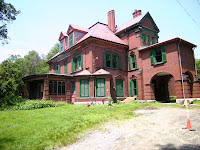
The Wilmington Historical Society now runs the Tavern as a museum and has tours on Tuesdays and Thursdays from 10:00 a.m. to 2:00 p.m. There is also agricultural machinery and reproductions of Colonial Militia flags on display in the carriage house adjacent to the Tavern.
430 Salem St.
Wilmington, Ma.
The Wilmington Historical Society now runs the Tavern as a museum and has tours on Tuesdays and Thursdays from 10:00 a.m. to 2:00 p.m. There is also agricultural machinery and reproductions of Colonial Militia flags on display in the carriage house adjacent to the Tavern.
Monday, August 4, 2008
Brooks Estate - Medford, Mass.
Brooks Estate
275 Grove St.
Medford, Mass.
Living in and surrounded by the crowded urban life of eastern Massachusetts today it is hard to imagine that in times past large tracts of open and sometimes forested, land still existed. Not just small working farms, but often the land was part and parcel of large estates owned by wealthy individuals and families. These personal estates, some of them consisting of hundreds of acres, were in most cases eventually broken up and sold off by the families descendants many years ago.
Occasionally, the estates were preserved long enough so that the open space remained, which we can now enjoy in public parks and conservation land. In some instances, the family mansions along with their grounds survived, giving us a glimpse of how they lived in the 18th and 19th centuries.
Founded in 1630, Medford was one of the earliest English settlements in the New World. Originally established as a "Plantation" it was owned by an absentee landlord in England. The Mystic River, which was one of its early boundaries, gave access to the sea and provided an abundance of "alewifes", a type of fish. (For which Alewife Brook Parkway, Rte. 16, was later named).
In 1660 Thomas Brooks, a puritan from Boston, purchased about 400 acres in Medford, establishing the Brooks Estate. The Brooks family went on to play an important role in the history of Medford, the Mass. Bay Colony and later in the Commonwealth of Massachusetts. To mention just two members of the family: John Brooks, a Captain in the American Revolution and a Major General in the militia, served as Governor of Massachusetts and the Rev. Charles Brooks was an influential minister, educator and an historian.
In the 1880s Peter Chardon Brooks III and Shepherd Brooks decided to build summer homes on their family owned property in Medford. At that time, Medford was still comparatively rural. Peter's home, Point of Rocks, no longer exists, but the manor built by Shepherd Brooks still stands.
Originally called the Acorn, the four bedroom red brick home was designed by Peabody and Sterns. Its granite foundation was built from stone taken from the old Middlesex Canal, a portion of which used to run through the Brooks Estate. A large carriage house was built adjacent to the manor.
In addition to building the two homes a massive construction effort was completed in the creation of Brooks pond. This pond was dug by hand and required the removal by trucks of tons of earth. At the same time vistas were opened up among the forested land to allow the proper viewing of the property.
The Brooks Estate decreased in size over the years as property was either sold - as in the creation of the Oak Grove Cemetery and its additions - or donated for public use. After the deaths of Peter and Shepherd, more of the property was sold by their heirs. In 1942 the City of Medford acquired what remained of the estate, which at that time was about 88 acres. Point of Rock was at this time demolished, leaving only the remains of its foundation. Shepherd Manor was used as both a nursing home and a place for veterans families.
275 Grove St.
Medford, Mass.
Occasionally, the estates were preserved long enough so that the open space remained, which we can now enjoy in public parks and conservation land. In some instances, the family mansions along with their grounds survived, giving us a glimpse of how they lived in the 18th and 19th centuries.
Founded in 1630, Medford was one of the earliest English settlements in the New World. Originally established as a "Plantation" it was owned by an absentee landlord in England. The Mystic River, which was one of its early boundaries, gave access to the sea and provided an abundance of "alewifes", a type of fish. (For which Alewife Brook Parkway, Rte. 16, was later named).
In 1660 Thomas Brooks, a puritan from Boston, purchased about 400 acres in Medford, establishing the Brooks Estate. The Brooks family went on to play an important role in the history of Medford, the Mass. Bay Colony and later in the Commonwealth of Massachusetts. To mention just two members of the family: John Brooks, a Captain in the American Revolution and a Major General in the militia, served as Governor of Massachusetts and the Rev. Charles Brooks was an influential minister, educator and an historian.
In the 1880s Peter Chardon Brooks III and Shepherd Brooks decided to build summer homes on their family owned property in Medford. At that time, Medford was still comparatively rural. Peter's home, Point of Rocks, no longer exists, but the manor built by Shepherd Brooks still stands.
In addition to building the two homes a massive construction effort was completed in the creation of Brooks pond. This pond was dug by hand and required the removal by trucks of tons of earth. At the same time vistas were opened up among the forested land to allow the proper viewing of the property.
Finally after some discussion, an agreement was reached on how best to preserve the property. Late in 1998 a permanent conservation plan was approved. This plan guarantees for future generations the preservation of some 50 acres of the Brooks Estate, the Shepherd Manor and its carriage house.
The property is managed by the Medford - Brooks Estate Land Trust (M-BLT). Year round caretakers live in Shepherd Manor, looking after the two historic buildings. The Brooks Estate is adjacent to Medford's Oak Grove Cemetery and conservation land (donated by the Brooks family) in Winchester. The estate has numerous hiking trails and is quite heavily forested, giving an illusion of distance from the surrounding city.
Thursday, July 31, 2008
Fort at #4 - Charlestown, New Hampshire
Fort at #4
267 Springfield Rd.
Rte. 11
Charlestown, N. H. 03603
The Fort at #4, in Charlestown, New Hampshire is a living history museum featuring a rebuilt 1740 palisade-style timber fort. Situated overlooking the Connecticut River the Fort was, at the time it was built, strategically located to protect the Massachusetts and later the New Hampshire frontier.
Prior to and during King Georges War (1744-1748) and the French and Indian War (1754 -1763), settlers in this area were subject to raids from both French and/or Indian war parties. Building and keeping the fort manned was considered very important in keeping northern Massachusetts towns safe from attack. This was also a way station for colonial and British troops on their way back and forth from the Forts at Ticonderoga and Crown Point in the later stages of the French and Indian War.
Captain Robert Rogers of Roger's Rangers fame is also associated with the Fort at #4. After conducting his successful raid on the Abenaki Indians settlement at St. Francis, Canada Rogers and his men faced a hazardous excursion. Having suffered only light casualties during the actual raid, the Rangers then had to travel through miles of dense forest while being pursued by the French and Native American tribesmen. Many of the Rangers were killed, wounded or captured during the pursuit. Finally arriving at the safety of the Fort at #4 the worn out surviving Rangers were met with much needed food and drink. The Rangers under Lt. John Stark also were responsible for building a military road between the fort and Crown Point in New York.
During the Revolutionary War the now deserted and dilapidated Fort was used by General John Stark again as a rallying point for Colonial soldiers.
The present day Fort was built in the 196o's in the town of Charlestown, New Hampshire. The Fort at #4 is owned by a non-profit organization operating as a Living History Museum and often hosting both French and Indian and Rev War reenactors. It is open to the public for the rest of the Summer and into the Fall, from 10:00 a.m. to 4:30 p.m. It is closed on Mondays and Tuesdays. It closes for the season in November and reopens in May.
267 Springfield Rd.
Rte. 11
Charlestown, N. H. 03603
The Fort at #4, in Charlestown, New Hampshire is a living history museum featuring a rebuilt 1740 palisade-style timber fort. Situated overlooking the Connecticut River the Fort was, at the time it was built, strategically located to protect the Massachusetts and later the New Hampshire frontier.Prior to and during King Georges War (1744-1748) and the French and Indian War (1754 -1763), settlers in this area were subject to raids from both French and/or Indian war parties. Building and keeping the fort manned was considered very important in keeping northern Massachusetts towns safe from attack. This was also a way station for colonial and British troops on their way back and forth from the Forts at Ticonderoga and Crown Point in the later stages of the French and Indian War.
Captain Robert Rogers of Roger's Rangers fame is also associated with the Fort at #4. After conducting his successful raid on the Abenaki Indians settlement at St. Francis, Canada Rogers and his men faced a hazardous excursion. Having suffered only light casualties during the actual raid, the Rangers then had to travel through miles of dense forest while being pursued by the French and Native American tribesmen. Many of the Rangers were killed, wounded or captured during the pursuit. Finally arriving at the safety of the Fort at #4 the worn out surviving Rangers were met with much needed food and drink. The Rangers under Lt. John Stark also were responsible for building a military road between the fort and Crown Point in New York.
During the Revolutionary War the now deserted and dilapidated Fort was used by General John Stark again as a rallying point for Colonial soldiers.
The present day Fort was built in the 196o's in the town of Charlestown, New Hampshire. The Fort at #4 is owned by a non-profit organization operating as a Living History Museum and often hosting both French and Indian and Rev War reenactors. It is open to the public for the rest of the Summer and into the Fall, from 10:00 a.m. to 4:30 p.m. It is closed on Mondays and Tuesdays. It closes for the season in November and reopens in May.
Friday, July 18, 2008
Battle Green, Lexington, Mass.
Battle Green
Lexington Center
Lexington, Mass.
In the early morning hours of April 19, 1775 a small expeditionary force of British soldiers, some 700 strong, entered the town of Lexington. Following the orders of their commander, General Gage, this mixed force of Grenadiers and Light infantry, led by Lt. Colonel Smith of the 10th Regiment, were hoping to quickly pass through Lexington and proceed onward to Concord.
General Gage was in receipt of new orders from London. More army regiments were being sent to Boston from England and Ireland to assist him, but in the meantime he was to take more proactive measures against the budding rebellion in the Massachusetts Bay Colony. Looking to follow up on the success of seizing powder from the colonial Powder House in Charlestown in September of 1774, Gage developed the much more ambitious plan of seizing the supplies at Concord.
Through the efforts of Dr. Warren and the Sons of Liberty his plans were soon learned and a watch was kept on the British garrison. When on April 18 it was observed preparations were being made for the expeditionary force, alarm riders were sent out into the countryside to warn the militia and to order out the "Minute Men" companies.
As for Colonel Smith, his mission depended upon secrecy and speed. Unfortunately for him and his men, the secret was out and his small force met up with a number of delays. Instead of being in Concord by sunrise, they were still in Lexington. Instead of meeting no armed resistance, they faced Captain Parker and his men on the village green. The skirmish that followed dashed the hopes of the British command for a bloodless coup
and a bloody war for freedom was begun.
Lexington Center
Lexington, Mass.
General Gage was in receipt of new orders from London. More army regiments were being sent to Boston from England and Ireland to assist him, but in the meantime he was to take more proactive measures against the budding rebellion in the Massachusetts Bay Colony. Looking to follow up on the success of seizing powder from the colonial Powder House in Charlestown in September of 1774, Gage developed the much more ambitious plan of seizing the supplies at Concord.
Through the efforts of Dr. Warren and the Sons of Liberty his plans were soon learned and a watch was kept on the British garrison. When on April 18 it was observed preparations were being made for the expeditionary force, alarm riders were sent out into the countryside to warn the militia and to order out the "Minute Men" companies.
and a bloody war for freedom was begun.
Wednesday, July 16, 2008
William Blaxton
William Blaxton Plaque
Beacon St.
Boston, Mass.
The Reverend William Blaxton (1595-1675) was the first European settler on the Shawmut peninsula - the future site of the Town of Boston. The peninsula was dominated by three large hills overlooking forested land, a protected harbor and a river (the Charles) that emptied into a marshy estuary. Connected to the mainland by a narrow strip of land, Shawmut was quite secluded and private - which, according to old accounts, was just how Rev. Blaxton liked it.
An Anglican Minister, educated at Cambridge in England, Blaxton arrived in the New World in 1623 with a group of settlers. When his fellow travelers moved back to England in 1625, Blaxton stayed on and settled onto Shawmut, living by himself. In 1629 Puritan settlers, seeking to establish a Massachusetts Bay Colony, arrived in what is now Charlestown - just across the harbor from Shawmut. Founding a viable community in that location proved to be difficult due to a lack of drinking water.
The official version of what happened next is that in 1630 Reverend Blaxton invited his new neighbors to come share the peninsula with him. At this time Shawmut consisted of some 487 acres of land, so there was plenty of room. John Winthrop, the governor of the colony, then made a deal with Blaxton buying the rights to the land, but leaving him with some 45 acres. This acreage encompassed a portion of Beacon Hill and the Boston Common.
In 1634, finding the Puritans difficult to live with - they were fervent believers in religious intolerance - Blaxton ended up selling his land back to them. The Boston Common (land) was thereby established and used for the training of militia and the grazing of cattle. After the sale Rev. Blaxton headed south and built a home in what is now part of Rhode Island.
Roger Williams was yet another refugee from Governor Winthrop's "city on a hill" who headed for Rhode Island. The two men became friendly and the Reverend Blaxton often gave sermons to Williams flock. Blaxton lived in a solitary house on a hill overlooking a river and filled the home with books. He married late in life and had one child. Blackstone Massachusetts, the Blackstone River and its valley are all named after him.
Beacon St.
Boston, Mass.
The Reverend William Blaxton (1595-1675) was the first European settler on the Shawmut peninsula - the future site of the Town of Boston. The peninsula was dominated by three large hills overlooking forested land, a protected harbor and a river (the Charles) that emptied into a marshy estuary. Connected to the mainland by a narrow strip of land, Shawmut was quite secluded and private - which, according to old accounts, was just how Rev. Blaxton liked it.An Anglican Minister, educated at Cambridge in England, Blaxton arrived in the New World in 1623 with a group of settlers. When his fellow travelers moved back to England in 1625, Blaxton stayed on and settled onto Shawmut, living by himself. In 1629 Puritan settlers, seeking to establish a Massachusetts Bay Colony, arrived in what is now Charlestown - just across the harbor from Shawmut. Founding a viable community in that location proved to be difficult due to a lack of drinking water.
The official version of what happened next is that in 1630 Reverend Blaxton invited his new neighbors to come share the peninsula with him. At this time Shawmut consisted of some 487 acres of land, so there was plenty of room. John Winthrop, the governor of the colony, then made a deal with Blaxton buying the rights to the land, but leaving him with some 45 acres. This acreage encompassed a portion of Beacon Hill and the Boston Common.In 1634, finding the Puritans difficult to live with - they were fervent believers in religious intolerance - Blaxton ended up selling his land back to them. The Boston Common (land) was thereby established and used for the training of militia and the grazing of cattle. After the sale Rev. Blaxton headed south and built a home in what is now part of Rhode Island.
Roger Williams was yet another refugee from Governor Winthrop's "city on a hill" who headed for Rhode Island. The two men became friendly and the Reverend Blaxton often gave sermons to Williams flock. Blaxton lived in a solitary house on a hill overlooking a river and filled the home with books. He married late in life and had one child. Blackstone Massachusetts, the Blackstone River and its valley are all named after him.
Tuesday, July 1, 2008
Old Burying Ground, Lexington, Mass.
Old Burying Ground
99 Harrington Road
The old burying ground in Lexington can be found just west of Lexington Green, near the Unitarian Church on Harrington Road. A large boulder marks the narrow foot path which leads to the entrance of the cemetery.
The burial ground dates back to 1690 when this area was still part of Cambridge. It wasn't until 1710 that the town of Lexington became its own parish. At the time of the Revolution, Lexington was mostly dairy farms, providing milk for Boston.
Additional lots were added over the years increasing the size of the cemetery. In time several hundred of Lexington's citizens were buried here. Among those that can be found here are the grave sites of the Reverends John Hancock and Jonas Clarke, Captain John Parker and an unknown British soldier, who was wounded in the fighting on April 19, 1775. He died three days later while being cared for at Buckman Tavern, just across the Battle Green from here.
Lexington remained largely an agricultural town until well into the 20th century. With the construction of Route 128/95 after the Second World War, and the population shift into Boston's suburbs, Lexington became the prosperous bedroom community it is today.
99 Harrington Road
Lexington, Mass.
The old burying ground in Lexington can be found just west of Lexington Green, near the Unitarian Church on Harrington Road. A large boulder marks the narrow foot path which leads to the entrance of the cemetery. The burial ground dates back to 1690 when this area was still part of Cambridge. It wasn't until 1710 that the town of Lexington became its own parish. At the time of the Revolution, Lexington was mostly dairy farms, providing milk for Boston.

Additional lots were added over the years increasing the size of the cemetery. In time several hundred of Lexington's citizens were buried here. Among those that can be found here are the grave sites of the Reverends John Hancock and Jonas Clarke, Captain John Parker and an unknown British soldier, who was wounded in the fighting on April 19, 1775. He died three days later while being cared for at Buckman Tavern, just across the Battle Green from here.
Lexington remained largely an agricultural town until well into the 20th century. With the construction of Route 128/95 after the Second World War, and the population shift into Boston's suburbs, Lexington became the prosperous bedroom community it is today.
Subscribe to:
Posts (Atom)