Showing posts with label Local Authors. Show all posts

Monday, April 27, 2009

"They Came Three Thousand Miles, and Died..."

Grave for British Soldiers
Old North Bridge
Monument St.
Concord, Mass.

Not far from the foot of the Old North Bridge there is a stone grave marker for the fallen soldiers of the 4th King's Own Light Company, killed nearby on 19 April 1775. Two British flags are placed in front of the memorial. The marker reads as follows:

Grave of British Soldiers
"They came three thousand miles, and died,
To keep the Past upon its throne:
Unheard, beyond the ocean tide,
Their English mother made her moan."
April 19, 1775

These lines are taken from the poem by James Russell Lowell (1819-1891) of Cambridge, Mass. a graduate of both Harvard College and Harvard Law and an ardent abolitionist.

"Lines, Suggested By the Graves of Two English Soldiers On Concord Battle-Ground" (1849)

The same good blood that now refills
The dotard Orient's shrunken veins,
The same whose vigor westward thrills,
Bursting Nevada's silver chains,
Poured here upon the April grass,
Freckled with red the herbage new;
On reeled the battle's trampling mass,
Back to the ash the bluebird flew.

Poured here in vain;--that sturdy blood
Was meant to make the earth more green,
But in a higher, gentler mood
Than broke this April noon serene;
Two graves are here: to mark the place,
At head and foot, an unhewn stone,
O'er which the herald lichens trace
The blazon of Oblivion.

These men were brave enough, and true
To the hired soldier's bull-dog creed;
What brought them here they never knew,
They fought as suits the English breed:
They came three thousand miles, and died,
To keep the Past upon its throne:
Unheard, beyond the ocean tide,
Their English mother made her moan.


The turf that covers them no thrill
Sends up to fire the heart and brain;
No stronger purpose nerves the will,
No hope renews its youth again:
From farm to farm the Concord glides,
And trails my fancy with its flow;
O'erhead the balanced hen-hawk slides,
Twinned in the river's heaven below.

But go, whose Bay State bosom stirs,
Proud of thy birth and neighbor's right,
Where sleep the heroic villagers
Borne red and stiff from Concord fight;
Thought Reuben, snatching down his gun,
Or Seth, as ebbed the life away,
What earthquake rifts would shoot and run
World-wide from that short April fray?

What then? With heart and hand they wrought,
According to their village light;
'Twas for the Future that they fought,
Their rustic faith in what was right.
Upon earth's tragic stage they burst
Unsummoned, in the humble sock;
Theirs the fifth act; the curtain first
Rose long ago on Charles's block.

Their graves have voices; if they threw
Dice charged with fates beyond their ken,
Yet to their instincts they were true,
And had the genius to be men.
Fine privilege of Freedom's host,
Of humblest soldiers for the Right!
--Age after age ye hold your post,
Your graves send courage forth, and might.

Monday, September 22, 2008

Saving Old Ironsides

U. S. S. Constitution

The U.S.S. Constitution was launched in 1797, one of six U.S. frigates ordered built in 1794 by Congress. These frigates would be the start of a new American Navy - at the conclusion of the American War for Independence, the Navy had been dissolved. Facing threats from both French privateers and Barbary Pirates the U. S. government realized it needed a Navy to protect its vital merchant fleet and its national interests.

The U.S.S. Constitution was a heavy frigate, carrying more guns than was usual for a frigate of the time. The ability to fire heavier broadsides, along with its strong construction, were instrumental in its great success as a fighting ship. Old Ironsides, as it affectionately came to be known, was never defeated in battle.

Old Ironsides greatest victories came in the The War of 1812. By defeating the British ships H.M.S. Guerriere and H.M.S. Java, the U.S.S. Constitution won everlasting fame.

In September of 1830 the Navy announced that the Constitution, now some thirty-three years old and needing extensive repair, would be scrapped. Dr. Oliver Wendell Holmes of Boston wasted no time in writing and having published this poem to lodge his personal complaint. A nation-wide protest led to the decision by Congress to fund the needed repairs.

In 1924 Old Ironsides was again on the chopping block. The frigate was in very poor condition and required a complete overhaul that would cost hundreds of thousands of dollars. A publicity campaign by the Elks Club enlisted the help of the nations schoolchildren, who contributed thousands of dollars by literally pitching in their pennies. Congress responded to popular pressure and provided the remainder of the funds.

Today the U.S.S. Constitution is the oldest commissioned war ship still afloat in the world. It has an a complement of active duty U.S. Navy personnel and is berthed in the old Charlestown Navy Yard in Boston. It is currently undergoing renovations, but it is open to the public for tours.

Saturday, September 20, 2008

The Saturday Club

Omni Parker House Hotel
60 School St.
Boston, Mass. 02108

The Saturday Club was a social club that during the mid-1800's met on the last Saturday of every month in the Parker House Hotel on School St. in Boston. But this wasn't just any social club - the Saturday Club was made up of some of the greatest writers and brightest minds to be found in America at that time. Ralph Waldo Emerson, Henry Wadsworth Longfellow, Professor Louis Agassiz, Dr. Oliver Wendell Holmes, Charles Francis Adams, Francis Parkman, James Russell Lowell, John Greenleaf Whittier and Nathaniel Hawthorne were just some of the members of the club.

During the early 1800's Boston gained the title of Athens of America and the Saturday Club meetings gave credence to the name. Charles Dickens, while a guest staying at the Parker House, joined a Club meeting and read from his work A Christmas Carol. At yet another gathering Longfellow worked on an early draft of his famous poem Paul Revere's Ride.

Prior to their meetings the club members would often visit the Old Corner Bookstore, which can still be found on the corner of School St. and Washington St. They would then have dinner before settling down on a Saturday afternoon to discuss poetry, literature and engage one another in conversation. In our modern non-literary age it is hard to imagine that a comparable group of people could be found in the same city, never mind meeting together under the same roof.

Sunday, August 31, 2008

The Celebrated Jumping Frog of Calaveras County

The Celebrated Jumping Frog
by Mark Twain

I recently met a former California native who is now living in the Boston area and is an avid Red Sox fan. During our conversation the discussion turned back to California and Calaveras County was mentioned - had I ever heard of it? I remembered the title of the famous Mark Twain story, so I said I did. This led to talk of the Calaveras County Fair, which continues to this day and present day life in California. I try to avoid mentioning today's politics in this blog, so I won't go down that road. But a look at Mark Twain, one of my favorite authors, is certainly called for.

Samuel Langhorne Clemens was born in 1835 in Florida, Missouri. He is of course most famous for his years growing up in Hannibal, Missouri, years that he immortalized in his own writings. Living on the banks of the Mississippi, before the outbreak of the Civil War, was paradise for such an imaginative youth. Growing up on the river, playing at being Pirates with his friends or dreaming of becoming that god-like creature, a riverboat pilot, gave Samuel Clemens all of the inspiration he needed to complete his most important works. (Ray Bradbury is another great author that comes to mind who received so much of his inspiration from his childhood).

After first working as a typesetter/printer and a sometime newspaper reporter, Sam Clemens did achieve his dream of becoming a riverboat pilot. Serving his apprenticeship under Horace Bixby, he memorized some 2,000 miles of the Mississippi River, along with all of its twists, turns, snags and sandbars - both upstream and downstream. This amazing feat of memory was required of all riverboat pilots, for which they were well-paid. Unfortunately for Clemens the coming of war in 1861 disrupted river traffic and put him out of a job. It did, however, provide the inspiration for his pen name Mark Twain. (Mark Twain was the term used to denote two fathoms (12 feet) of water under the keel of a riverboat).

Samuel Clemens missed serving in the Civil War by going west with his brother Orion. Orion had been appointed Secretary of the territory of Nevada and Sam took the opportunity to join him. Clemens again picked up his writing career in the boomtown of Virginia City, Nevada by writing for local newspapers. (He also tried his hand at mining, at which he failed).

For a time he wrote for a newspaper in San Francisco and it was while he was in California that he experienced life in the gold mining camps. A story he heard in the camp of Angel, California led to his writing the short story that launched his literary career - The Celebrated Jumping Frog of Calaveras County. (The frog jumping tradition continues at the annual Calaveras County fair).

Some of Clemens happiest and most prolific years (1874-1891) were spent in the house he and his wife Olivia had built in Hartford, Connecticut. His two most famous novels, The Adventures of Tom Sawyer and Adventures of Huckleberry Finn, were completed while living here. The novel Adventures of Huckleberry Finn is considered his greatest work.

Samuel Clemens later years were unhappy years due to the premature deaths of two of his three daughters and by the death of his beloved wife Livy in 1904. Samuel Clemens died in 1910, while Halley's Comet was visible in the night sky - just as it was upon his birth in 1835.

Wednesday, August 20, 2008

Wadsworth House

Wadsworth House
1341 Mass. Ave.
Cambridge, Mass. 02138

Wadsworth House was built in 1726-1727 to house the Presidents of Harvard College. Its first occupant was Benjamin Wadsworth, Harvard's eighth President. A total of nine Harvard Presidents have lived in the home. Edward Everett, the last President to reside here, was President of Harvard from 1846 - 1849.

In July of 1775 General George Washington arrived in Cambridge to accept his new appointment as Commander-in-Chief of the Continental Army. Gen. Washington stayed briefly in Wadsworth House while more spacious accommodations were cleaned and prepared for him. Washington and his "family" moved into the Vassal-Craigie-Longfellow house that same month.

Located right in the middle of bustling Harvard Square, Wadsworth House is a throwback to the past, a reminder of what the village of Old Cambridge looked like in the 18th century. A quiet village where on nearby Brattle Street you might find the blacksmith (or smithy) of Longfellow's famous poem The Village Blacksmith.

Wadsworth House is currently used by Harvard University for faculty and administrative offices.

Saturday, August 9, 2008

Col. Glover's Regiment returns to Cambridge

Longfellow House
National Historic Site
105 Brattle St.
Cambridge, Mass. 02138

Saturday afternoon, after a 233 year hiatus, Col. John Glover's Marblehead Regiment returned to Longfellow's House in Cambridge and set up camp. The last time the Glover's were encamped here was in 1775 when General George Washington was living here and the Glover's were serving as the Headquarters Guard.

Col. Glovers Regiment of colonial militia made up part of the 16,000 man force that had answered the call after the fighting of April 19, 1775 and were holding Boston and its occupying British forces in a stage of siege. Besides serving as the Headquarters Guard, the Glover's were a "rapid response" unit ready to reinforce any part of the siege lines that fell under attack.

Deciding he needed a naval force to raid British supply vessels, Gen. Washington again made use of the Glover's. The regiment was a mixed group, largely made up of sailors and fisherman, which made it the perfect choice for this mission. Detached from duty in Cambridge, they established a naval raiding force in Beverly, Mass., which included Col. Glover's own schooner, the Hannah.

In December of 1775 Glovers Regiment was disbanded and Col. Glover was ordered to begin recruiting troops for his new Regiment, the 14th Continental Regiment. Col. Glover and the 14th Regiment went on to serve throughout the war and provided much needed amphibious and marine capabilities to the Continental Army.

In August of 1776, in a heavy fog, the 14th Regiment ferried the brunt of the Continental Army from Brooklyn to New York, saving them from certain defeat and capture. Again on Christmas Day in 1776 they rowed Gen. Washington and his troops across the Delaware, in poor weather conditions, to attack a Hessian force at Trenton, New Jersey. Taking part in the fighting, they then ferried the victorious Americans back across the Delaware, along with the prisoners they had taken.

The recreated Col. Glover's Regiment is based in Marblehead, Massachusetts. In addition to attending various Revolutionary War reenactments, they are well known for their boisterous annual (every July) weekend encampment held at Fort Sewall, Marblehead.

Monday, August 4, 2008

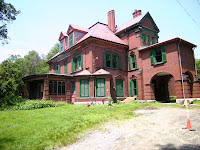
Brooks Estate - Medford, Mass.

Brooks Estate
275 Grove St.
Medford, Mass.

Living in and surrounded by the crowded urban life of eastern Massachusetts today it is hard to imagine that in times past large tracts of open and sometimes forested, land still existed. Not just small working farms, but often the land was part and parcel of large estates owned by wealthy individuals and families. These personal estates, some of them consisting of hundreds of acres, were in most cases eventually broken up and sold off by the families descendants many years ago.

Occasionally, the estates were preserved long enough so that the open space remained, which we can now enjoy in public parks and conservation land. In some instances, the family mansions along with their grounds survived, giving us a glimpse of how they lived in the 18th and 19th centuries.

Founded in 1630, Medford was one of the earliest English settlements in the New World. Originally established as a "Plantation" it was owned by an absentee landlord in England. The Mystic River, which was one of its early boundaries, gave access to the sea and provided an abundance of "alewifes", a type of fish. (For which Alewife Brook Parkway, Rte. 16, was later named).

In 1660 Thomas Brooks, a puritan from Boston, purchased about 400 acres in Medford, establishing the Brooks Estate. The Brooks family went on to play an important role in the history of Medford, the Mass. Bay Colony and later in the Commonwealth of Massachusetts. To mention just two members of the family: John Brooks, a Captain in the American Revolution and a Major General in the militia, served as Governor of Massachusetts and the Rev. Charles Brooks was an influential minister, educator and an historian.

In the 1880s Peter Chardon Brooks III and Shepherd Brooks decided to build summer homes on their family owned property in Medford. At that time, Medford was still comparatively rural. Peter's home, Point of Rocks, no longer exists, but the manor built by Shepherd Brooks still stands.

Originally called the Acorn, the four bedroom red brick home was designed by Peabody and Sterns. Its granite foundation was built from stone taken from the old Middlesex Canal, a portion of which used to run through the Brooks Estate. A large carriage house was built adjacent to the manor.

In addition to building the two homes a massive construction effort was completed in the creation of Brooks pond. This pond was dug by hand and required the removal by trucks of tons of earth. At the same time vistas were opened up among the forested land to allow the proper viewing of the property.

The Brooks Estate decreased in size over the years as property was either sold - as in the creation of the Oak Grove Cemetery and its additions - or donated for public use. After the deaths of Peter and Shepherd, more of the property was sold by their heirs. In 1942 the City of Medford acquired what remained of the estate, which at that time was about 88 acres. Point of Rock was at this time demolished, leaving only the remains of its foundation. Shepherd Manor was used as both a nursing home and a place for veterans families.

Finally after some discussion, an agreement was reached on how best to preserve the property. Late in 1998 a permanent conservation plan was approved. This plan guarantees for future generations the preservation of some 50 acres of the Brooks Estate, the Shepherd Manor and its carriage house.

The property is managed by the Medford - Brooks Estate Land Trust (M-BLT). Year round caretakers live in Shepherd Manor, looking after the two historic buildings. The Brooks Estate is adjacent to Medford's Oak Grove Cemetery and conservation land (donated by the Brooks family) in Winchester. The estate has numerous hiking trails and is quite heavily forested, giving an illusion of distance from the surrounding city.

Saturday, June 14, 2008

The Wayside Inn

The Wayside Inn
72 Wayside Road
Sudbury, Mass.

Located on the Old Boston Post Road "Howes Tavern" was well situated to receive drovers and other travelers on the road between Worcester and Boston. Established by David Howe in 1716, the tavern and inn remained open and in the family until 1861. David's son, Ezekiel, a Lt. Colonel in the Sudbury militia, first inherited the inn and increased its prosperity. It was Ezekiel Howe who led the men of Sudbury on their march to the North bridge in Concord on April 19, 1775.

In 1863 Henry Wadsworth Longfellow published his famous poem "Tales of the Wayside Inn". Longfellow used the setting of the inn for his poem and its fictitious characters. The Inn was renamed in honor of the poem. Henry Ford later acquired the property and its surrounding grounds in the 1920's. It is thought that Ford originally planned on creating an historical village - he went so far as to build a chapel, a granary mill and move an old school house on to the property - but that did not come to fruition. He did establish the non-profit organization that owns and operates the Wayside Inn today.

The Wayside Inn continues to offer its guests fine New England style dining, overnight accommodations, a gift shop and a small museum. Function rooms for weddings and parties are also available. As an added bonus, it is quite common to see living historians, in period dress, roaming about the Inn and its grounds. During the winter the 4th King's Own conducts its drills every other Sunday on the grounds of the Wayside Inn. Feel free to ask a member of the 4th for a musket demonstration or just say hello, as they relax in the tavern after their exertions in the cold.

Friday, May 30, 2008

Longfellow House - Cambridge, Mass.

Longfellow House
105 Brattle St.
Cambridge, Mass. 02138

The Vassall-Craigie-Longfellow House was built in 1759 by John Vassall, a wealthy planter and a Loyalist. Like many of his neighbors on Brattle St. he left Cambridge for Boston in 1774 as the politics of the day forced him to choose sides. His home was then confiscated by Provincial/Revolutionary authorities.

General George Washington began using the Vassall house as his headquarters after arriving in Cambridge and assuming command of the Continental Army in 1775. He resided here from July, 1775 to April of 1776 and it was from here that he planned and led the siege of Boston. When the British Navy finally sailed out of Boston (along with approximately 1100 Loyalists) the war then moved on to New York and General Washington went south.

After the war Andrew Craigie, who was the Apothecary General of the Continental Army, purchased the Vassall home and lived here from 1791. Craigie was a wealthy real estate speculator and made a lot of improvements to the property. It was Craigie who added on the wings to the home and added an addition onto the back. Craigie lost his fortune and after that the house fell on bad times, eventually being broken up into rooms for rent.

In 1837 the home was purchased as a wedding gift and it's most famous literary occupant moved in - Henry Wadsworth Longfellow. Longfellow, originally of Portland, Maine, was a Professor of Modern Languages at Harvard College. Living in such an historic home certainly inspired Longfellow and it is reflected in his works. One of his most famous poems is "Paul Revere's Ride", which tells the tale of the events that occurred locally April 18-19 in 1775. Longfellow lived here until his death
in 1882.

The Longfellow House can be found just outside of Harvard Square and is owned and managed by the National Park Service. From June 4 to September house tours are offered @ 10:30 and 11:30 a.m. and on the hour from 1:00 p.m. to 4:00 p.m. The grounds are open to the public from dawn to dusk. (The property at one time extended as far as the Charles River).

Wednesday, May 21, 2008

Rev. War Memorial on Cambridge Common

Cambridge Common
Harvard Square
Cambridge, Mass.

There is a minor mystery associated with these three British cannon that have been sitting on the Cambridge Common for over one hundred thirty years: where exactly did they come from and what role did they play in the American Revolution?

The easy answer is the one provided on the small cement marker next to the cannon. It simply states that the three cannon had been emplaced in Fort William and were left behind when the British forces left Boston in March of 1776. But this marker is fairly new and as I have stated before in this Blog, I have learned over the years that you can't always believe what you read.

I know from my visits to the Cambridge Common many years ago that this site used to be much simpler, with fewer monuments and the cannon used to be arrayed a little differently. I seem to remember reading a marker that stated the cannon were part of the artillery train brought to Cambridge by Col. Henry Knox in his haul from Ft. Ticonderoga and Crown Point. Also, one of the cannon is French in origin, which having been captured in Cnanda during the French and Indian War, could have been transported to one of those two places.

Now I know you can't always rely on your memory, so I investigated further. I've checked a number of sources - both off and on-line - and the sources, so far, all seem to tell the same narrative. In 1875 the Massachusetts State legislature gave these three cannon to the City of Cambridge to place on the Cambridge Common and to hold in perpetuity (as long as they were properly maintained) from stocks held at the State Armory. (John Fiskes account refers to them as "three huge war dogs").

The sources also agree with my memory that these cannon were originally brought down to Cambridge from Crown Point by Col. Henry Knox to help bring to an end the siege of Boston. That puts a different spin on things and certainly makes the cannon all the more important historically. I'm going to investigate further, but for now I'm going to side with historian John Fiske (among others).