Showing posts with label Historic Site. Show all posts

Thursday, July 9, 2009

"Weekend With the Glovers"

Glover's Encampment
Fort Sewall
Front St.
Marblehead, Mass.

This weekend (July 10-12) Col. Glover's regiment will be hosting their annual summer encampment at Fort Sewall in Marblehead. Starting on Friday, re-enactors from all over New England will turn this former colonial era fort into an Revolutionary War encampment, with units representing Colonial militia, the British Navy and British Regulars (to include the King's Own) on hand.

The highlight of the weekend for the viewing public will be, as always, the pitched battles through the streets of Marblehead between the Colonial militia and the armed forces of His Majesty King George III. There are two battles scheduled for Saturday, one in the morning at 10:15 and another in the afternoon at 2:00.

Fort Sewall is open to the public until sunset and public facilities are available. Parking in the area adjacent to the Fort is very limited.

Thursday, May 14, 2009

Grand Re-Opening for Hancock-Clarke House

Hancock-Clarke House
36 Hancock St.
Lexington, Mass.

The Lexington Historical Society will conduct a grand re-opening celebration for the Hancock-Clarke House in Lexington on Sunday May 17 from 10:00 a.m. to 4:00 p.m. The property has just undergone a year long extensive renovation. There will be a ribbon cutting ceremony at 2:00 p.m. and tours of the house will be conducted. Everyone is invited to attend.

Monday, August 11, 2008

Fort Ticonderoga faces financial challenge

Fort Ticonderoga
Ticonderoga, New York 12883

The trustees of Fort Ticonderoga have a problem that many other historical foundations and organizations have faced over the years - a debt crisis. Funding a operation like Fort Ticonderoga (which is a privately owned not-for-profit organization) from year to year is very expensive and it is just like operating a business. You have to pay your employees (volunteers can only do so much) and for your utilities, insurance, maintenance and upkeep.

Unfortunately, all of these expenses cannot be met simply by the cost of admission or the sales in your gift shop or restaurant. Fort Ticonderoga has also had to deal with declining numbers of visitors over the past few years. In order to attract new visitors and to meet the needs of today's visitor, Fort Ticonderoga has been making changes. A new facility has been built with the Deborah Clarke Mars Education Center, the footprint of the Fort has been expanded and concrete has replaced the old mortar and stone that formerly supported the walls of the Fort. This is important because of the frost heaves that winter in the Northeast brings every year.

In order to meet budgetary shortfalls and to fund this expansion Fort Ticonderoga was fortunate enough to have wealthy benefactors: the Mars family. Forest Mars, former CEO of Mars Inc. and heir to the family fortune and his wife Deborah, have donated millions to to the Fort. Deborah Mars was born in Ticonderoga, New York and is president of the board of trustees.

Unfortunately, there was a "falling out" between Forest and Deborah Mars and Fort Ticonderoga's executive director, Nicholas Westbrook. The Mars' apparently felt slighted in the treatment they received from Westbrook and in February of this year severed their relationship with the Fort - by email. Fort Ticonderoga was suddenly left with a $2.5 million debt with no apparent means of paying the bills.

The trustees now face a Hobsons choice: sell some of its assets or possibly be forced to close the Fort. Fort Ticonderoga and its museum has in its possession millions of dollars worth of artwork and historic artifacts. One painting by Thomas Cole, "Gelyna, view near Ticonderoga", could by itself fetch over a million dollars.

Fort Ticonderoga is important both for the important historical role it played in two wars, the American Revolution and the French and Indian War and for its part in educating the public about our history. One of the first popular tourist attractions in this country, for almost two hundred years people have been visiting this destination. Permanently closing such a unique place as Fort Ticonderoga would be a great shame.

Saturday, August 9, 2008

Col. Glover's Regiment returns to Cambridge

Longfellow House
National Historic Site
105 Brattle St.
Cambridge, Mass. 02138

Saturday afternoon, after a 233 year hiatus, Col. John Glover's Marblehead Regiment returned to Longfellow's House in Cambridge and set up camp. The last time the Glover's were encamped here was in 1775 when General George Washington was living here and the Glover's were serving as the Headquarters Guard.

Col. Glovers Regiment of colonial militia made up part of the 16,000 man force that had answered the call after the fighting of April 19, 1775 and were holding Boston and its occupying British forces in a stage of siege. Besides serving as the Headquarters Guard, the Glover's were a "rapid response" unit ready to reinforce any part of the siege lines that fell under attack.

Deciding he needed a naval force to raid British supply vessels, Gen. Washington again made use of the Glover's. The regiment was a mixed group, largely made up of sailors and fisherman, which made it the perfect choice for this mission. Detached from duty in Cambridge, they established a naval raiding force in Beverly, Mass., which included Col. Glover's own schooner, the Hannah.

In December of 1775 Glovers Regiment was disbanded and Col. Glover was ordered to begin recruiting troops for his new Regiment, the 14th Continental Regiment. Col. Glover and the 14th Regiment went on to serve throughout the war and provided much needed amphibious and marine capabilities to the Continental Army.

In August of 1776, in a heavy fog, the 14th Regiment ferried the brunt of the Continental Army from Brooklyn to New York, saving them from certain defeat and capture. Again on Christmas Day in 1776 they rowed Gen. Washington and his troops across the Delaware, in poor weather conditions, to attack a Hessian force at Trenton, New Jersey. Taking part in the fighting, they then ferried the victorious Americans back across the Delaware, along with the prisoners they had taken.

The recreated Col. Glover's Regiment is based in Marblehead, Massachusetts. In addition to attending various Revolutionary War reenactments, they are well known for their boisterous annual (every July) weekend encampment held at Fort Sewall, Marblehead.

Wednesday, August 6, 2008

The Middlesex Canal

Middlesex Canal @
Baldwin Mansion
2 Alfred St.
Woburn, Mass.

On June 22, 1793 Governor John Hancock of Massachusetts, signed a document authorizing the construction of the Middlesex Canal. Built with private funding, the canal was to run from the Merrimack River at Middlesex Village (Lowell) to Medford. A later addition to the canal extended its length to Charlestown. This was a very ambitious civil engineering project for its time and a precursor to the more famous Erie Canal in New York.

Built under the direction of Loammi Baldwin, a veteran of the Revolutionary War, the canal was to be some 27 miles long, 3o feet in width, 3 feet in depth and have 20 locks and several aqueducts. The colorful wooden barges that floated down the canal carried both passengers and freight. Farmers and proprietors in New Hampshire and northern Massachusetts no longer had to depend upon the tides of the Merrimack River or the poor roads to get their products to Boston markets. The return trip supplied manufactured goods from Boston, Medford etc. to the interior

The Middlesex Canal began its operations in 1803 and continued to operate successfully until the 1840's. Having put regular freight and stage companies at a competitive disadvantage, the canal was unable to compete against the newest transportation technology - the railroad. The directors of the Middlesex Canal were forced to shut down operations and declare bankruptcy in 1851.

Falling into disuse the canal has mostly been filled in or paved over. Portions of the old canal are still visible in Woburn and in Billerica, where the Middlesex Canal Association makes its home. This association is dedicated to preserving the memory of this late 18th - early 19th century "engineering marvel".

Monday, August 4, 2008

Brooks Estate - Medford, Mass.

Brooks Estate
275 Grove St.
Medford, Mass.

Living in and surrounded by the crowded urban life of eastern Massachusetts today it is hard to imagine that in times past large tracts of open and sometimes forested, land still existed. Not just small working farms, but often the land was part and parcel of large estates owned by wealthy individuals and families. These personal estates, some of them consisting of hundreds of acres, were in most cases eventually broken up and sold off by the families descendants many years ago.

Occasionally, the estates were preserved long enough so that the open space remained, which we can now enjoy in public parks and conservation land. In some instances, the family mansions along with their grounds survived, giving us a glimpse of how they lived in the 18th and 19th centuries.

Founded in 1630, Medford was one of the earliest English settlements in the New World. Originally established as a "Plantation" it was owned by an absentee landlord in England. The Mystic River, which was one of its early boundaries, gave access to the sea and provided an abundance of "alewifes", a type of fish. (For which Alewife Brook Parkway, Rte. 16, was later named).

In 1660 Thomas Brooks, a puritan from Boston, purchased about 400 acres in Medford, establishing the Brooks Estate. The Brooks family went on to play an important role in the history of Medford, the Mass. Bay Colony and later in the Commonwealth of Massachusetts. To mention just two members of the family: John Brooks, a Captain in the American Revolution and a Major General in the militia, served as Governor of Massachusetts and the Rev. Charles Brooks was an influential minister, educator and an historian.

In the 1880s Peter Chardon Brooks III and Shepherd Brooks decided to build summer homes on their family owned property in Medford. At that time, Medford was still comparatively rural. Peter's home, Point of Rocks, no longer exists, but the manor built by Shepherd Brooks still stands.
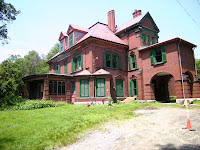
Originally called the Acorn, the four bedroom red brick home was designed by Peabody and Sterns. Its granite foundation was built from stone taken from the old Middlesex Canal, a portion of which used to run through the Brooks Estate. A large carriage house was built adjacent to the manor.

In addition to building the two homes a massive construction effort was completed in the creation of Brooks pond. This pond was dug by hand and required the removal by trucks of tons of earth. At the same time vistas were opened up among the forested land to allow the proper viewing of the property.

The Brooks Estate decreased in size over the years as property was either sold - as in the creation of the Oak Grove Cemetery and its additions - or donated for public use. After the deaths of Peter and Shepherd, more of the property was sold by their heirs. In 1942 the City of Medford acquired what remained of the estate, which at that time was about 88 acres. Point of Rock was at this time demolished, leaving only the remains of its foundation. Shepherd Manor was used as both a nursing home and a place for veterans families.

Finally after some discussion, an agreement was reached on how best to preserve the property. Late in 1998 a permanent conservation plan was approved. This plan guarantees for future generations the preservation of some 50 acres of the Brooks Estate, the Shepherd Manor and its carriage house.

The property is managed by the Medford - Brooks Estate Land Trust (M-BLT). Year round caretakers live in Shepherd Manor, looking after the two historic buildings. The Brooks Estate is adjacent to Medford's Oak Grove Cemetery and conservation land (donated by the Brooks family) in Winchester. The estate has numerous hiking trails and is quite heavily forested, giving an illusion of distance from the surrounding city.

Saturday, August 2, 2008

The Slave Wall - Medford, Mass.

The Slave Wall
Grove St.
Medford, Mass.

This brick wall on Grove St., Medford was purportedly built by a slave named Pomp in 1765. At that time Pomp was owned by Thomas Brooks and the wall that he built was part of the outer entrance to the home and estate of the Brooks family. The original home no longer exists. The public park behind the wall was land donated in 1924 by the Brooks family.

The Brooks were a prominent family in Medford from its early days and at one time owned 400+ acres in the town. A portion of the Brooks estate and a late 19th century Queen Anne style summer home can be found a short distance away at 275 Grove St. The estate is managed by the Medford-Brooks Estate land trust and is open to the public.

The Brooks family wasn't the only wealthy family in the town to own slaves. The Royall family, transplanted from Antigua, owned 27 slaves and had an estate of almost 600 acres. Their colonial mansion with its separate slave quarters still survives.

Many others in Medford were involved in the actual slave trade itself. Medford was a part of the "Triangle Trade" which consisted of bringing Rum to Africa to trade for slaves, who were then brought to the West Indies to be sold. A portion of the proceeds was then used to buy sugar and molasses, which when brought back to Medford was used to produce Rum. (Medford became known throughout the world for its high quality Rum. Rum continued to be produced in Medford until 1905 when the last factory shut its doors).

Slavery was finally abolished in Massachusetts in 1783 making Massachusetts the first state to abolish slavery.

Monday, July 14, 2008

Fort Sewall, Marblehead, Mass.

Fort Sewall
N/E end of Front St.
Marblehead, Mass.

Originally a part of the Town of Salem, by 1622 fisherman were making use of Marblehead harbor and its surroundings. The first settlers arrived here in 1629 and soon established their own community. Years later, still seeking to become fully independent of Salem and looking to provide for their own defense, it was determined to build fortifications on what was then called Gale's Head. In 1644 the General Court provided two cannon and some ammunition and a Fort of simple earthwork construction was built.

Due to the fear of French raiders, the Fort was expanded into the size and layout that we find today. This work was completed in 1742. By the time of the American Revolution the fort had a few cannon, with some powder and it had a small garrison. But it was during the War of 1812 that Fort Sewall played in its most important, or at least its most famous, role.

On Sunday April 3, 1814 the U.S.S. Constitution was being closely pursued by two British frigates, the Tenedos and the Endymion. Outgunned by the combined firepower of the two vessels, the Captain of "Old Ironsides" chose the better part of valor and sailed into Marblehead harbor, under the protective guns of the Fort. The famous fighting ship was saved to fight yet another day.

It was in that same year (1814) that the Fort was named after Marblehead resident and Chief Justice of Massachusetts, Samuel Sewall. In 1860, with the outbreak of the Civil War and facing a new enemy, the town appropriated money to again make needed repairs to the old fort. Along with funds from the U.S. government the work was completed and the Fort was manned by men from Massachusetts.

In 1922 custody of Fort Sewall was given over to the Town of Marblehead for the creation of a public park. The cannon and the gun emplacements are now long gone. What you will find instead is a paved walkway around the "bowl" of the Fort, with benches for seating. Some of the offices and guard rooms remain, but entrance to the lower magazines is blocked off.

The park is open from dawn to dusk, providing an excellent view of Marblehead harbor. There are restrooms located on site, but parking is limited.

Tuesday, July 1, 2008

Old Burying Ground, Lexington, Mass.

Old Burying Ground
99 Harrington Road
Lexington, Mass.
The old burying ground in Lexington can be found just west of Lexington Green, near the Unitarian Church on Harrington Road. A large boulder marks the narrow foot path which leads to the entrance of the cemetery.

The burial ground dates back to 1690 when this area was still part of Cambridge. It wasn't until 1710 that the town of Lexington became its own parish. At the time of the Revolution, Lexington was mostly dairy farms, providing milk for Boston.

Additional lots were added over the years increasing the size of the cemetery. In time several hundred of Lexington's citizens were buried here. Among those that can be found here are the grave sites of the Reverends John Hancock and Jonas Clarke, Captain John Parker and an unknown British soldier, who was wounded in the fighting on April 19, 1775. He died three days later while being cared for at Buckman Tavern, just across the Battle Green from here.

Lexington remained largely an agricultural town until well into the 20th century. With the construction of Route 128/95 after the Second World War, and the population shift into Boston's suburbs, Lexington became the prosperous bedroom community it is today.

Saturday, June 28, 2008

Old Burial Ground, Arlington, Mass.

Old Burial Ground
Pleasant St.
Arlington, Mass.
Just behind the Unitarian church, on the corner of Mass. Ave. and Pleasant St. in Arlington, lies the old Menotomy burial ground. Established in 1732, headstones for many members of Menotomy's most prominent families, as well as a number of Revolutionary War veterans, can be found here. (As of today's date these latter graves are marked with American flags).

Jason Russell was buried here in a mass grave along with eleven members of the colonial militia killed in the fighting on April 19, 1775. Russell was killed on the grounds of his family home, which is not far from here. The site of some the most brutal fighting of that day, ten members of the militia, including seven men from the town of Danvers, died at the Russell homestead. Two British soldiers were also killed at that site. (The men from Danvers were buried back in their home town).

In 1842 an 19-foot white marble obelisk, surrounded by a short metal fence, was erected in the cemetery. The remains of Jason Russell and the others were removed from the original grave and reinterred here under the obelisk. The original inscription reads:

"Erected by the Inhabitants of West Cambridge, A.D. 1848, over the common grave of Jason Russell, Jason Winship, Jabez Wyman and nine others, who were slain in this town by the British Troops on their retreat from the Battles of Lexington and Concord, April 19, 1775. Being among the first to lay down their lives in the struggle for American Independence."

Just behind the obelisk can be found the original headstone that marks Jason Russell's final resting spot. The faded inscription on the slate headstone is as follows: "Mr. Jason Russell was barbarously murdered in his own house by Gage's bloody troops, on the 19th of April, 1775, aetatis 59. His body is quietly resting in this grave with Eleven of our friends, who in like manner, with many others, were cruelly slain, on that fatal day. Blessed are the dead who die in the Lord." Right beside Jason's headstone is his wife's, Elizabeth Russell. She died in 1786 at the age of 65.

Next to a stone wall that borders the cemetery there is a solitary British flag. This marks the presumed burial spot of British soldiers killed in the fighting of April 19. The soldiers were placed in unmarked graves in an area reserved for the burial of slaves. It is entirely possible that the two British soldiers killed at the Jason Russell house are also buried at this location - just a stones toss from the men they died fighting.

Saturday, June 14, 2008

The Wayside Inn

The Wayside Inn
72 Wayside Road
Sudbury, Mass.

Located on the Old Boston Post Road "Howes Tavern" was well situated to receive drovers and other travelers on the road between Worcester and Boston. Established by David Howe in 1716, the tavern and inn remained open and in the family until 1861. David's son, Ezekiel, a Lt. Colonel in the Sudbury militia, first inherited the inn and increased its prosperity. It was Ezekiel Howe who led the men of Sudbury on their march to the North bridge in Concord on April 19, 1775.

In 1863 Henry Wadsworth Longfellow published his famous poem "Tales of the Wayside Inn". Longfellow used the setting of the inn for his poem and its fictitious characters. The Inn was renamed in honor of the poem. Henry Ford later acquired the property and its surrounding grounds in the 1920's. It is thought that Ford originally planned on creating an historical village - he went so far as to build a chapel, a granary mill and move an old school house on to the property - but that did not come to fruition. He did establish the non-profit organization that owns and operates the Wayside Inn today.

The Wayside Inn continues to offer its guests fine New England style dining, overnight accommodations, a gift shop and a small museum. Function rooms for weddings and parties are also available. As an added bonus, it is quite common to see living historians, in period dress, roaming about the Inn and its grounds. During the winter the 4th King's Own conducts its drills every other Sunday on the grounds of the Wayside Inn. Feel free to ask a member of the 4th for a musket demonstration or just say hello, as they relax in the tavern after their exertions in the cold.

Friday, May 30, 2008

Longfellow House - Cambridge, Mass.

Longfellow House
105 Brattle St.
Cambridge, Mass. 02138

The Vassall-Craigie-Longfellow House was built in 1759 by John Vassall, a wealthy planter and a Loyalist. Like many of his neighbors on Brattle St. he left Cambridge for Boston in 1774 as the politics of the day forced him to choose sides. His home was then confiscated by Provincial/Revolutionary authorities.

General George Washington began using the Vassall house as his headquarters after arriving in Cambridge and assuming command of the Continental Army in 1775. He resided here from July, 1775 to April of 1776 and it was from here that he planned and led the siege of Boston. When the British Navy finally sailed out of Boston (along with approximately 1100 Loyalists) the war then moved on to New York and General Washington went south.

After the war Andrew Craigie, who was the Apothecary General of the Continental Army, purchased the Vassall home and lived here from 1791. Craigie was a wealthy real estate speculator and made a lot of improvements to the property. It was Craigie who added on the wings to the home and added an addition onto the back. Craigie lost his fortune and after that the house fell on bad times, eventually being broken up into rooms for rent.

In 1837 the home was purchased as a wedding gift and it's most famous literary occupant moved in - Henry Wadsworth Longfellow. Longfellow, originally of Portland, Maine, was a Professor of Modern Languages at Harvard College. Living in such an historic home certainly inspired Longfellow and it is reflected in his works. One of his most famous poems is "Paul Revere's Ride", which tells the tale of the events that occurred locally April 18-19 in 1775. Longfellow lived here until his death
in 1882.

The Longfellow House can be found just outside of Harvard Square and is owned and managed by the National Park Service. From June 4 to September house tours are offered @ 10:30 and 11:30 a.m. and on the hour from 1:00 p.m. to 4:00 p.m. The grounds are open to the public from dawn to dusk. (The property at one time extended as far as the Charles River).

Wednesday, May 21, 2008

Rev. War Memorial on Cambridge Common

Cambridge Common
Harvard Square
Cambridge, Mass.

There is a minor mystery associated with these three British cannon that have been sitting on the Cambridge Common for over one hundred thirty years: where exactly did they come from and what role did they play in the American Revolution?

The easy answer is the one provided on the small cement marker next to the cannon. It simply states that the three cannon had been emplaced in Fort William and were left behind when the British forces left Boston in March of 1776. But this marker is fairly new and as I have stated before in this Blog, I have learned over the years that you can't always believe what you read.

I know from my visits to the Cambridge Common many years ago that this site used to be much simpler, with fewer monuments and the cannon used to be arrayed a little differently. I seem to remember reading a marker that stated the cannon were part of the artillery train brought to Cambridge by Col. Henry Knox in his haul from Ft. Ticonderoga and Crown Point. Also, one of the cannon is French in origin, which having been captured in Cnanda during the French and Indian War, could have been transported to one of those two places.

Now I know you can't always rely on your memory, so I investigated further. I've checked a number of sources - both off and on-line - and the sources, so far, all seem to tell the same narrative. In 1875 the Massachusetts State legislature gave these three cannon to the City of Cambridge to place on the Cambridge Common and to hold in perpetuity (as long as they were properly maintained) from stocks held at the State Armory. (John Fiskes account refers to them as "three huge war dogs").

The sources also agree with my memory that these cannon were originally brought down to Cambridge from Crown Point by Col. Henry Knox to help bring to an end the siege of Boston. That puts a different spin on things and certainly makes the cannon all the more important historically. I'm going to investigate further, but for now I'm going to side with historian John Fiske (among others).

Sunday, May 18, 2008

Grand Opening of the Edmund Fowle House

Edmund Fowle House
28 Marshall St.
Watertown, Mass.

The Historical Society of Watertown celebrated the Grand Opening of the Edmund Fowle house on Saturday (May 17). The Society has recently completed an extensive and very expensive restoration of the property, which had deteriorated to the point where it was no longer considered safe for occupancy. A number of local dignitaries along with members of various Colonial Militia units, including the Sudbury Militia, were in attendance to help with the opening ceremonies.

The Fowle house, built in 1772, in addition to its age and its beautiful architecture is also significant for its history. Committees from the Provincial Congress met here in 1775 and 1776. It was also an important meeting place after General Washington accepted command of the Continental Army and began conducting the siege of Boston. On July 19, 1776 a international treaty - the Watertown Treaty - was signed here between the Governors of the State of Massachusetts Bay and delegates from the St. Johns and the Micmac tribes from Nova Scotia, Canada.

The Historical Society, the Massachusetts legislature (which contributed $700,000), the many individuals and groups who donated time and effort and ultimately the Massachusetts taxpayer, are to be commended for restoring this important piece of history.

The Edmund Fowle house is owned and operated by the Historical Society of Watertown. Visiting hours for the house and its museum is 1-4 p.m. on every third Sunday during the summer months. Admission is $5.00 for adults, Senior Citizens and children under 12 are admitted for $3.00.

Friday, April 25, 2008

Prince Estabrook Memorial

Prince Estabrook Memorial
Buckman Tavern
One Bedford St.
Lexington, Mass.

On Patriot's Day, April 21, 2008, at 12 noon, members of the modern day Lexington Minute Men Company gathered in front of Buckman Tavern to dedicate a new memorial to one of their own -Prince Estabrook. Estabrook, a slave from Lexington, was with the Lexington Training Band on Lexington Green as they stood in defiance of the British Regulars on the morning of April 19, 1775. He was wounded in the resulting skirmish. Prince Estabrook is considered to be the first black soldier to fight for independence in the American Revolution. He was later given his own freedom in recognition for his service.

Friday, October 26, 2007

New names added to Lexington Memorial

Lexington Frieze-Memorial
@ Buckman Tavern
One Bedford St.
Lexington, Mass.

On Saturday October 13, 2007 a ceremony was held to mark the addition of three new names to the Lexington Frieze-Memorial located next to Buckman Tavern, which is adjacent to Lexington Green. The ceremony was hosted by the Lexington Training Band and featured a wreath laying ceremony and the firing of musket volleys. The names added to the already existing list are: Thaddeus Bowman, Sgt. Francis Brown and Nathaniel Bowman. Sgt. Brown was wounded in the afternoon of April 19, 1775 and Nathaniel Bowman was killed that same day. This memorial is dedicated to those men who gathered on Lexington Green in the early hours of April 19,1775 and defied, albeit briefly, the British Crown's forces. Eight members of the militia lost their lives either on the Green or its immediate environs that morning and eleven were wounded.

Tuesday, October 23, 2007

The Jason Russell House

The Jason Russell House
7 Jason St.
Arlington, Mass.

This 18th century home is best known for the fighting that took place here on the afternoon of April 19, 1775. After engagements that morning on Lexington Green and at the North Bridge in Concord the remnants of a 700-man expeditionary force of British soldiers and Marines, along with a relief force of an additional 1,000 troops, were attempting to make their way back to Boston.

Thousands of militia from the surrounding communities, many in organized companies, but some coming singly or in small groups, were laying in ambush all along their route. A mixed group of militia, including men from as far away as Woburn and Danvers, decided to make their stand at the Russell homestead.

As they proceeded along Concord Road (what is now Mass. Ave.) the British Regulars sent out flankers to clear the houses that lined the road of any opposition. This brutal house to house fighting resulted in the deaths of many in Menotomy (present-day Arlington) and Cambridge.

Here at the Russell homestead British Light Infantry engaged the militia in some of the bitterest fighting of the day. Jason Russell was bayoneted several times and died just outside his home. Ten other men of the militia, including seven men from Danvers, also perished as well as two British soldiers.

Members of the Russell family lived here until 1896. It is now owned and operated by the Arlington Historical Society.

Friday, August 31, 2007

On this day in History...

The Powder House
Powder House Square
Somerville, Mass.

On September 1, 1774 a hand-picked force of Regulars, led by Lt-Colonel George Maddison of the King's Own 4th Regiment, left Boston on a special mission for British Commander General Gage. Loaded into Navy longboats they were first rowed up the Mystic River and then marched inland. Their objective was the Powder House (magazine) in what was then part of Charlestown.

Having been given the keys by the Middlesex Sheriff, the soldiers removed 250 half-barrels of gunpowder and then made their way back to Boston. A small detachment went into Cambridge and carried off two brass cannon. General Gage's preemptive strike at the arms and munitions of the Militia companies of the Bay Colony had succeeded.

But this action was viewed with great alarm by the populace and resulted in the calling out of the militia and mass demonstrations. British troops continued to mount similar operations into the countryside, culminating in the events of April 19 , 1775, which instigated the hostilities that led to America's War for Independence.